Skid Steer Mulchers, Drums or Discs, Flow, Cooling and Sizing
How to pick between drum and disc heads, match hydraulic flow and cooling, and size your skid steer to the vegetation. Includes a spec table.
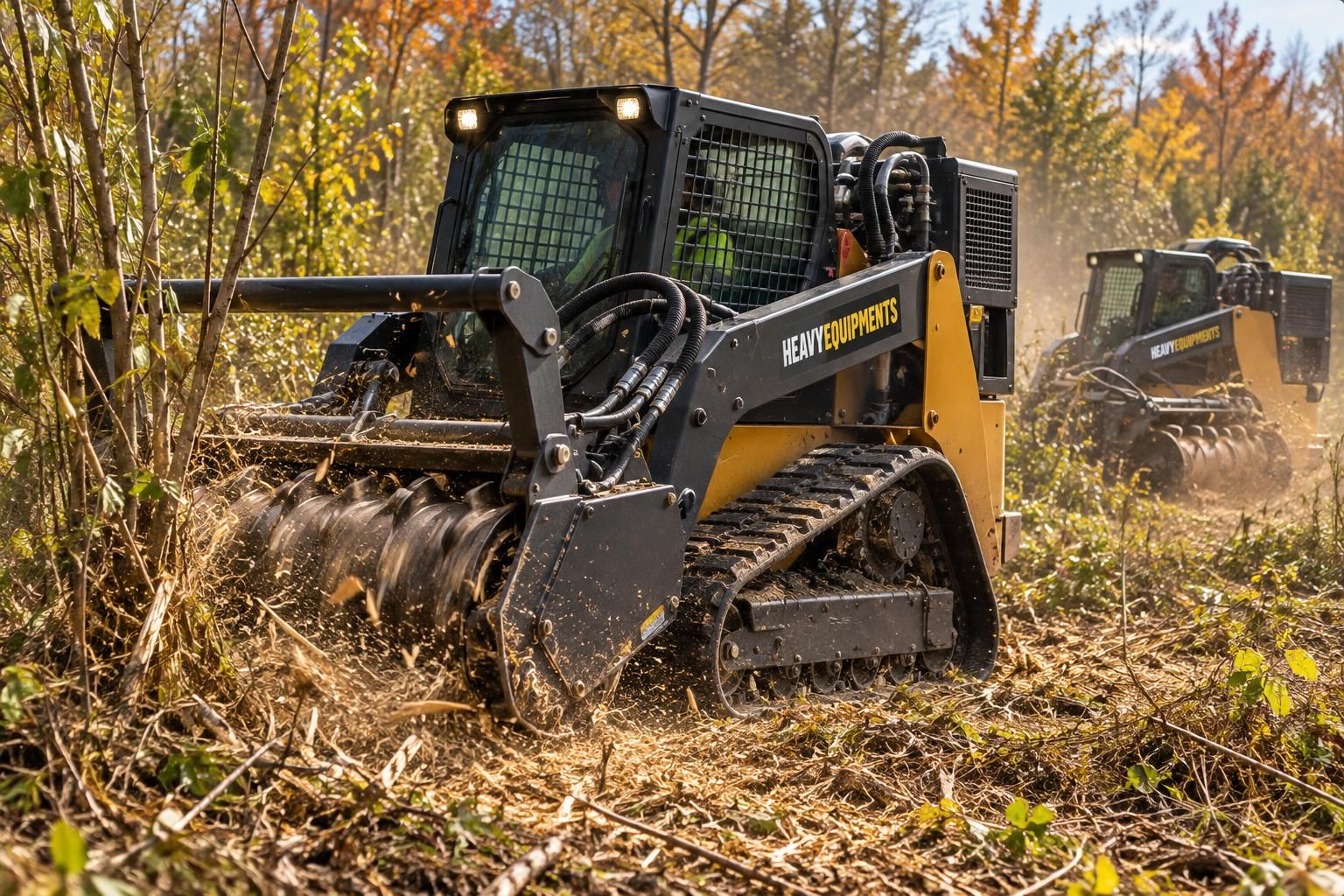
Mulching brush and small trees with a skid steer can be fast and clean if the head and machine are a good match. This guide breaks down drum vs. disc skid steer mulchers, how hydraulic flow and cooling factor in, and how to size your machine to the vegetation you’re tackling. We’ve also included a spec table of popular skid steers to help you shortlist options and compare capacity.
Drum and disc mulcher differences
Both head styles shred woody material, but they behave differently in the cut.
- Drum mulchers use a cylindrical rotor with fixed or swinging teeth. They generally leave a more even finish on the ground, control thrown debris better, and reward steady, methodical feed rates. Many crews prefer drums for right-of-way maintenance and work close to property lines.
- Disc mulchers spin a heavy disc with teeth around the perimeter. They can be aggressive on upright stems and help directionally push and process small trees. Expect more chip throw and a rougher finish; give them extra clearance around structures and public areas.
On the machine side, drum heads tend to favor smooth hydraulics and consistent carrier power. Disc heads leverage rotor inertia and like strong cooling to manage heat from repeated heavy hits. If site safety and finish quality are key, lean drum; if you’re toppling and processing woody stems in the open, a disc can be compelling.
Hydraulic flow pressure and cooling tips
Mulchers are among the most demanding skid steer attachments because they convert hydraulic power directly into cutting torque and heat. Three carrier factors matter:
- Auxiliary flow matters. Heads are built around a target flow range. For context, the John Deere 125 lists a Pump Capacity of 56.8 LPM (15.0 GPM), which is in the standard-flow realm. Many drum heads are designed for higher-flow circuits. Match the attachment’s required flow to your machine’s auxiliary hydraulics, and confirm coupler size/type.
- System pressure and a case drain matter. Pressure translates to torque, and many mulchers also require a case drain (third line) to protect the motor from pressure spikes. Verify the head’s plumbing requirements before you rent or buy.
- Cooling is critical. Mulching builds heat quickly. Machines with strong hydraulic cooling, clean coolers, and reversing fans tend to keep head speed up over longer shifts. Monitor temps and clean debris screens frequently.
If you’re pursuing a skid steer mulcher rental, ask specifically about the head’s required flow and case drain, and whether the carrier is set up with a forestry door and guarding.
Sizing by vegetation and production goals
Think about what you’ll cut most of the time, then pick a machine/head combination to match. Use the horsepower, rated operating capacity (ROC), and operating weight in the table below as a reality check.
- Light brush and maintenance passes: Smaller, lighter heads on carriers in the 60 to mid 70 HP class can be effective for grass, vines, and light brush. Examples in that bracket include Case SR160 (44.7 kW/60.0 HP), Kubota SSV65 (47.7 kW/64.0 HP), Bobcat S595 (55.2 kW/74.0 HP), and Cat 246D (55.4 kW/74.3 HP).
- Mixed brush with frequent saplings: Stepping up in capacity helps keep rotor speed up and reduces stalling. Consider machines like Bobcat S650 (55.4 kW/74.3 HP), Kubota SSV75 (55.4 kW/74.3 HP), Cat 262B (61.1 kW/82.0 HP), John Deere 328E (64.1 kW/86.0 HP), or Case 90XT (63.4 kW/85.0 HP).
- Heavy regrowth and small trees: More power and mass stabilize the carrier and sustain head speed. Look at Bobcat S770 (68.6 kW/92.0 HP), Cat 272D (73.1 kW/98.0 HP), and John Deere 332G (74.6 kW/100.0 HP).
Rated operating capacity (50% of tipping load) is worth attention: a mulcher is a front heavy load that extends in front of the coupler. A higher ROC offers a stability margin, especially when working on slopes or reaching into brush piles. Operating weight also helps keep the machine planted.
Skid steers for mulcher pairing specs
Use this table to size your carrier by horsepower, ROC at 50% tipping, operating weight, and lift design. Link through for full specs.
| Model | Lift design | Horsepower | ROC (50% tipping) | Operating weight | Tipping load |
|---|---|---|---|---|---|
| Bobcat S595 | Vertical | 55.2 kW (74.0 HP) | 997.9 kg (2200 lbs) | 3081.3 kg (6793 lbs) | 1995.8 kg (4400 lbs) |
| Bobcat S650 | Vertical | 55.4 kW (74.3 HP) | 1220.2 kg (2690 lbs) | 3777.1 kg (8327 lbs) | 2440.3 kg (5380 lbs) |
| Bobcat S750 | Vertical | 63.4 kW (85.0 HP) | 1451.5 kg (3200 lbs) | 4033.8 kg (8893 lbs) | 2903.0 kg (6400 lbs) |
| Bobcat S770 | Vertical | 68.6 kW (92.0 HP) | 1519.5 kg (3350 lbs) | 4161.7 kg (9175 lbs) | 3039.1 kg (6700 lbs) |
| Caterpillar 246d | Radial | 55.4 kW (74.3 HP) | 975.2 kg (2150 lbs) | 3367.5 kg (7424 lbs) | 1950.4 kg (4300 lbs) |
| Caterpillar 262B | Vertical | 61.1 kW (82.0 HP) | 1224.7 kg (2700 lbs) | 3565.0 kg (7859 lbs) | 2449.4 kg (5400 lbs) |
| Caterpillar 272d | Vertical | 73.1 kW (98.0 HP) | 1451.5 kg (3200 lbs) | 3742.1 kg (8250 lbs) | 2903.0 kg (6400 lbs) |
| John Deere 332G | Vertical | 74.6 kW (100.0 HP) | 1701 kg (3750 lbs) | 4540 kg (10000 lbs) | 3269 kg (7200 lbs) |
| John Deere 328e | Vertical | 64.1 kW (86.0 HP) | 1270.1 kg (2800 lbs) | 3978.0 kg (8770 lbs) | 2540.1 kg (5600 lbs) |
| John Deere 8875 | Vertical | 48.0 kW (64.4 HP) | 1065.9 kg (2350 lbs) | 3175.4 kg (7000 lbs) | 2268.0 kg (5000 lbs) |
| Kubota Ssv65 | Vertical | 47.7 kW (64.0 HP) | 884.5 kg (1950 lbs) | 3197.8 kg (7050 lbs) | 1769.0 kg (3900 lbs) |
| Kubota Ssv75 | Vertical | 55.4 kW (74.3 HP) | 1220.2 kg (2690 lbs) | 3819.8 kg (8421 lbs) | 2440.0 kg (5379 lbs) |
| Case 95XT | Radial | 63.4 kW (85.0 HP) | 1428.8 kg (3150 lbs) | 4105.0 kg (9050 lbs) | 2857.6 kg (6300 lbs) |
| Case 90XT | Radial | 63.4 kW (85.0 HP) | 1111.3 kg (2450 lbs) | 4059.7 kg (8950 lbs) | 2222.2 kg (4900 lbs) |
| Case Sr160 | Radial | 44.7 kW (60.0 HP) | 725.7 kg (1600 lbs) | 2499.3 kg (5510 lbs) | 1451.5 kg (3200 lbs) |
Lift path stability and head width
Vertical-lift machines offer more reach at height (useful when stacking or backdragging mulch), while radial-lift machines can feel planted at mid-lift where most mulching happens. Either works; focus on ROC and operating weight for stability. When choosing head width, match the attachment to your machine’s power and the site: narrower heads can keep rotor speed up in dense material and are easier on lighter carriers; wider heads cover open ground faster on higher-output machines.
Setup and safety checklist
- Use a forestry door, FOPS/ROPS in good condition, hose armor, rear and side guarding, and debris curtains on the head.
- Confirm the auxiliary flow setting, correct couplers, and a case drain if the head requires it. Inspect lines for abrasion and leaks.
- Clean coolers, verify fan direction, and make sure screens are clear. Watch temps throughout the day.
- Bring the head to speed before engaging material, maintain a consistent feed rate, and avoid biting too deep. Work downhill when possible, and clear around stumps and rocks to protect teeth.
- Carry an extinguisher, clear duff from belly pans, and avoid parking on hot material.
- Establish exclusion zones, since disc heads can throw chips farther. Post a spotter when working near roads, utilities, or structures.
Buying or rental practical tips
If you’re testing the waters or tackling a one-off project, a skid steer mulcher rental can make sense. Ask the rental yard to send a matched package (carrier plus head) with the correct hydraulic setup and guarding, and confirm whether teeth wear is included or chargeable. For ownership, factor in tooth costs and downtime for sharpening or replacements, and consider a forestry package if you’ll mulch regularly.
Next steps and resources
- Compare detailed specs side by side at /specs/compare/ and browse our database at /specs/.
- Shop carriers and heads on /for-sale/ or line up a matched package on /rentals/.
- Find mulcher heads and related skid steer attachments on /attachments/, and keep machines running with /parts/.
Whether you choose a drum or disc, the right combination of flow, cooling, horsepower, and ROC will determine how productive your skid steer mulcher is in your material. Use the table above to shortlist carriers, then match a head to your hydraulics and target vegetation.