Backhoe Rental Rates, Delivery, and Key Attachments
A contractor’s guide to backhoe rental with rate drivers, delivery checkpoints, and the right attachments for trenching, utility, and cleanup work.
Renting a backhoe loader is often the fastest way to add trenching, loading, and utility capability to your site, without tying up capital. This guide explains what typically drives backhoe rental rates (qualitatively), what to line up for delivery and hauling, and which attachments can save hours on common jobs. It also includes a spec snapshot of backhoe models you will encounter in the field so you can size the right machine before you call a rental desk.
What really drives backhoe rental rates
Rental pricing varies by market and supplier, but the levers are consistent. Use these to predict where a unit will land on the rate curve, without guessing dollar figures:
- Size and weight. Heavier, higher power machines generally command higher rates and cost more to haul. For example, models in the 6,300 to 7,150 kg range (many Cat 416/420 series) sit differently on transport than compact units or very light machines like the Case 646.
- Hydraulic capability. If you need hammers or augers, check pump capacity and flow. Machines with higher flow (for example, New Holland B95/B95LR at 151.0 to 151.4 LPM) support more demanding hydraulic tools and may price higher than low flow units.
- Drivetrain. 4WD improves traction and productivity on soft or uneven ground, and can influence both the rate and the minimum haul setup. Several JCB 3CX variants specify JCB 4WD transmissions.
- Attachments and accessories. Buckets, forks, hammers, augers, and couplers each add cost. The hydraulic demand and lift requirements of those tools should match the base machine (see table below).
- Term and logistics. Delivery distance, minimums, and how long you keep the unit affect the final invoice. Longer jobs usually reduce the per day charge, while short drop ins can be more expensive per day.
- Fuel type and site support. Most backhoes are diesel, but a few legacy gas machines exist. Plan refueling accordingly to avoid service calls.
Size your rental with real specs
The table below lists a cross section of backhoe loaders commonly seen in the field. Scan horsepower, operating weight, hydraulic flow, lift capacity, and length to narrow choices. If you need to run a breaker or auger, start with pump capacity. If you are pallet handling or loading trucks, check lift capacity. For detailed side by side views, use Compare Specs or browse all makes in Specs.
| Model | Power | Operating weight | Pump flow/capacity | Lift capacity | Transmission/Drive | Length | Notes |
|---|---|---|---|---|---|---|---|
| JCB 3CX | 68 kW | 8,000 kg | Not listed | Not listed | Wheeled (4x4) | Not listed | Max digging depth 5,460 mm; Diesel |
| JCB 3CX4SMT | 67.3 kW (90.2 HP) | 8069.4 kg (17790 lbs) | 136.3 LPM (36 GPM) | 3170.6 kg (6990 lbs) | JCB 4WD | Not listed | Diesel; Fuel cap 160.1 l (42.3 gal) |
| JCB 3CX4 | 61.7 kW (82.7 HP) | 7370.9 kg (16250 lbs) | 124.2 LPM (32.8 GPM) | 3497.2 kg (7710 lbs) | JCB 4WD | Not listed | Diesel; Fuel cap 160.1 l (42.3 gal) |
| JCB 3CX2 | 61.7 kW (82.7 HP) | Not listed | 124.2 LPM (32.8 GPM) | 3497.2 kg (7710 lbs) | JCB 2WD | Not listed | Diesel; 4 forward gears |
| JCB 2CX Streetmaster | 55.3 kW (74.2 HP) | Not listed | 79.1 LPM (20.9 GPM) | 2095.6 kg (4620 lbs) | Syncroshuttle | Not listed | Diesel; Net 51.5 kW (69.1 HP) |
| Caterpillar 426B | 58.9 kW (79.0 HP) | 6700.0 kg (14771.0 lbs) | 155.2 LPM (41.0 GPM) | Not listed | Power shuttle | 696.0 cm (274.0 in.) | Diesel; 1992 to 1996 |
| Caterpillar 420D | 66.0 kW (88.6 HP) | 7150.0 kg (15763.0 lbs) | 162.8 LPM (43.0 GPM) | Not listed | Auto-Shift | 697.0 cm (274.4 in.) | Diesel; 2000 to 2006 |
| Caterpillar 416E | 55.2 kW (74.1 HP) | 6795.0 kg (14980.4 lbs) | Not listed | Not listed | Power shuttle | 723.0 cm (284.6 in.) | Diesel; 2006 onward |
| Caterpillar 416D | 55.2 kW (74.1 HP) | 6900.0 kg (15211.9 lbs) | Not listed | Not listed | Power shuttle | 694.0 cm (273.2 in.) | Diesel; 2000 to 2006 |
| Caterpillar 416C | 55.9 kW (75.0 HP) | 6335.0 kg (13966.3 lbs) | Not listed | Not listed | Not listed | 697.0 cm (274.4 in.) | Diesel; 1996 to 2001 |
| John Deere 350B | 31.1 kW (41.7 HP) | 5410.0 kg | 87.1 LPM (23.0 GPM) | Not listed | Shuttle | 367.0 cm (144.5 in.) | Gasoline; 1970 to 1974 |
| John Deere 210LE | 58.3 kW (78.1 HP) | 4140.0 kg (9127.1 lbs) | 94.6 LPM (25.0 GPM) | 3115.0 kg (6867.4 lbs) | Full power shift | 523.0 cm (205.9 in.) | Diesel; 1997 to 2007 |
| John Deere 350C | 34.3 kW (46.0 HP) | 4808.0 kg | Not listed | Not listed | Shuttle with wet disc clutch | 339.0 cm | Diesel; 1975 to 1985 |
| John Deere 440 | Not listed | 2005.0 kg | Not listed | Not listed | Gear type with dry disc clutch | Not listed | Gasoline; 1958 to 1960 |
| John Deere 450C | 52.2 kW (70.0 HP) | 6500.0 kg (14330.0 lbs) | 87.1 LPM (15.0 GPM (56.8 LPM) 23.0 GPM) | Not listed | Partial power shift with dry disc clutch | Not listed | Diesel; 1973 to 1982 |
| Case 646 | 12.3 kW (16.5 HP) | 539.0 kg (1188.3 lbs) | 34.1 LPM (9.0 GPM) | Not listed | Hydrostatic | 274.0 cm (107.9 in.) | Gasoline; 1972 to 1980 |
| Case 580E | 51.5 kW (69.0 HP) | 5116.0 kg | 113.6 LPM (30.0 GPM) | Not listed | Power shuttle | 688.0 cm (270.9 in.) | Diesel; 1983 |
| Case 530 CK Construction King | 38.2 kW (47.6 HP) | 1580.0 kg | 83.3 LPM (20.0 GPM / 22.0 GPM) | Not listed | Torque converter | 657.0 cm (258.7 in.) | Gasoline; 1960 to 1967 |
| Case 430CK Construction King | 31.3 kW (42.0 HP) | 1645.0 kg | 62.5 LPM (Loader 13.5 GPM; Backhoe 16.5 GPM) | Not listed | Mechanical shuttle with dry disc clutch | 299.0 cm | Diesel; 1960 to 1966 |
| Case 580B Construction King | 32.1 kW (43.1 HP) | 5000.0 kg | Not listed | Not listed | Hydrostatic | 660.0 cm | Gasoline; 1971 to 1976 |
| New Holland 555E | 61.9 kW (83 HP) | 6459.2 kg (14240 lbs) | 143.8 LPM (38 GPM) | 3084.4 kg (6800 lbs) | Power shuttle | Not listed | Not listed |
| New Holland LB90.B | 70.8 kW (95 HP) | 8341.6 kg (18390 lbs) | 151.0 LPM (39.9 GPM) | 3551.6 kg (7830 lbs) | PowerShuttle | Not listed | Diesel |
| New Holland B95 | 71.1 kW (95.3 HP) | 6549.9 kg (14440 lbs) | 151.0 LPM (39.9 GPM) | 3601.5 kg (7940 lbs) | Power-reversing/torque converter | Not listed | Not listed |
| New Holland B95LR | 70.8 kW (95 HP) | 6558.9 kg (14460 lbs) | 151.4 LPM (40 GPM) | 3601.5 kg (7940 lbs) | Power-reversing/torque converter | Not listed | Not listed |
How to use the table
- For trenching and utility work, start with hydraulic flow and power to match augers or breakers. Models listing 136 to 163 LPM and 36 to 43 GPM will run more demanding tools than low flow units.
- For loading and forks, check lift capacity where provided. Units around 3,100 to 3,600 kg lift are suited to heavier pallets and pipe handling, and always verify your load charts on site.
- For access and transport, verify length and operating weight against your delivery truck or trailer and jobsite approach. Heavier, longer machines need more room to maneuver and stage.
- Match ground conditions with the drivetrain. Favor 4WD or comparable drive systems for soft ground. On paved work, a compact street oriented machine can be efficient.
Delivery and hauling checklist
Lock these items in before your rental start to avoid delays:
- Confirm the machine’s weight and length for transport planning. For instance, many Cat 416/420 models list 6,335 to 7,150 kg with lengths near 697 to 723 cm, while compact units may be far lighter and shorter.
- Match the trailer or truck to the machine operating weight and overall length, plus any attachment bundle riding along (forks, hammer, extra buckets).
- Check the access route. Compare turn radii at gates and staging areas against the machine’s listed length. Clear overhead obstructions and mark underground utilities before you dig.
- Set a fuel plan. Most units are diesel, and a few legacy gasoline machines appear in the spec set. Line up the correct fuel on site to avoid service calls or idle time.
- Select tires and drive to suit the site. If you expect mud or uneven subgrade, request a 4WD transmission or drive. If most work is on pavement, a lighter unit can be easier to haul and stage.
Attachments that save hours
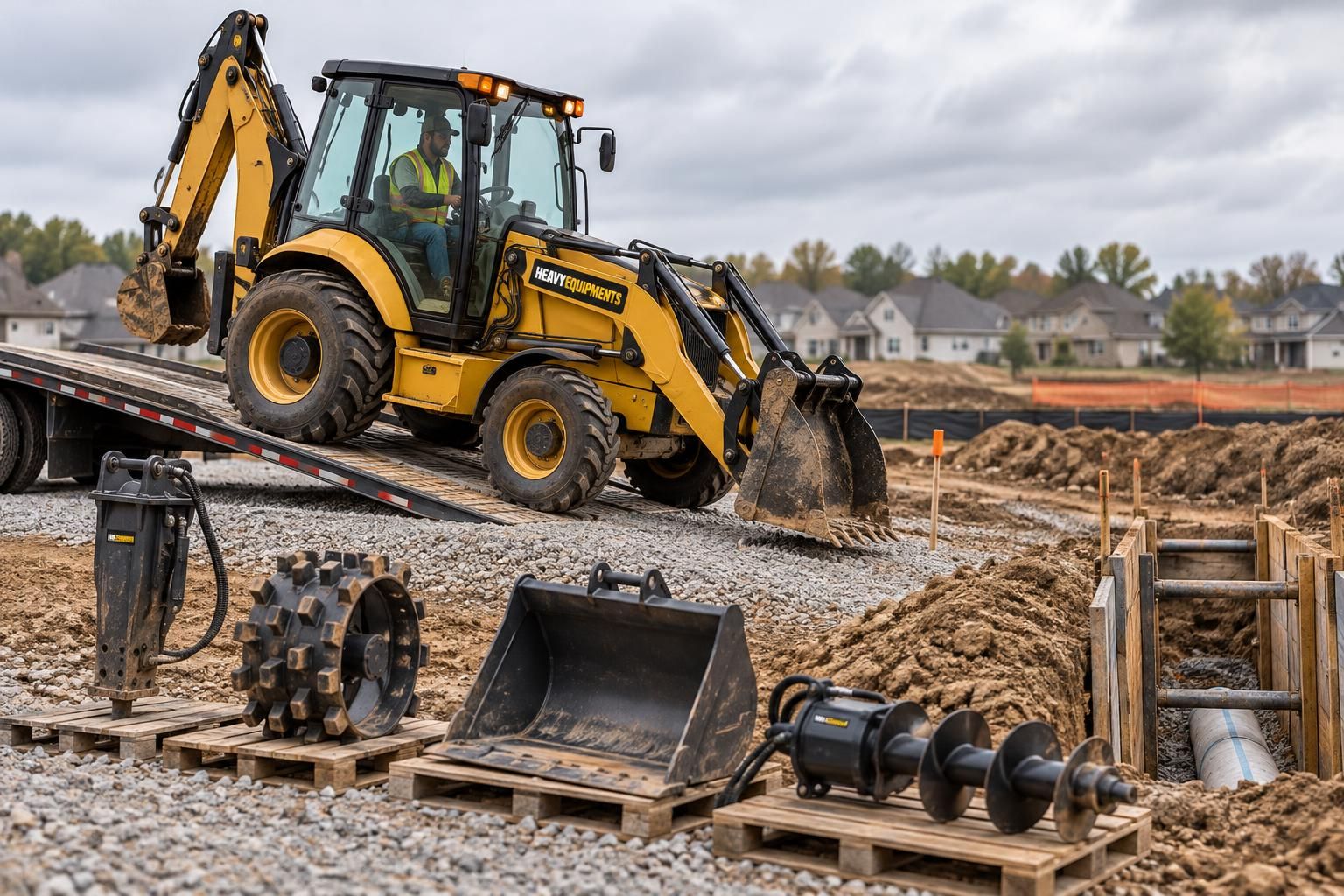
Attachments can turn a one day trench into a half day job, if your backhoe’s specs match the tool. Coordinate with your rental house and use the table as a starting point.
- Hydraulic breaker (hammer). Prioritize machines with higher pump flow. Models listing roughly 136 to 163 LPM and around 36 to 43 GPM support many mid size breakers, and always confirm tool flow and pressure requirements against the machine circuit.
- Auger drive. Continuous, steady flow matters. Units in the 124 to 151 LPM (32.8 to 39.9 GPM) range are common auger platforms. Choose bit diameter for soil and utility spacing, and verify the coupler interface ahead of delivery.
- 4‑in‑1 (multi‑purpose) bucket. This speeds site cleanup, backfilling, and light grading. Check the backhoe lift capacity if you expect to grab heavier debris or handle pallets.
- Pallet forks. Useful for moving pipe, pallets, and trench boxes. Compare expected load weight to the machine listed lift capacity and keep loads low when traveling.
- Street or cleanup tools. On road work, compact machines with moderate flow, such as those in the 79 to 114 LPM range, pair well with brooms or light hydraulics and are easier to position curbside.
- Quick coupler. Even if you only switch between two buckets, a coupler can reclaim setup time across a short rental.
Spec first rental tips
- Match the machine to the task. If trenching is primary, confirm digging depth requirements against the model capability. If tool use dominates, size by hydraulic flow first.
- Balance power and footprint. Higher horsepower helps in heavy digging, but added weight and length can slow moves on tight sites.
- Mind the drivetrain. 4WD transmissions improve utilization on soft ground, and 2WD can be fine for firm, flat, paved jobs.
- Plan for fuel and service windows. Verify fuel type (diesel vs gasoline in older units). Ask the rental yard how they handle fueling between longer term shifts.
- Bundle what you will actually use. Each added tool increases handling and cost. Prioritize the one or two attachments that remove the most manual steps on your scope.
Next steps for your backhoe rental
- Shortlist machines and run a side by side in Compare Specs, or browse more models in Specs.
- Ready to book? Start with Heavy Equipment Rental to request availability and delivery.
- If ownership makes more sense after a long job, check current listings under Backhoe for Sale.
- Need a specific bucket, fork set, or breaker? Browse Attachments. For wear items and maintenance support, see Parts.