Wheel Loader Buckets and Couplers, Types and Sizing Guide
A practical guide to wheel loader buckets and couplers. Learn types, capacity sizing, and quick attach compatibility.
Whether you run a compact wheel loader or a production-class machine, getting buckets and couplers right has a bigger impact on cycle times and cost per ton than almost any other attachment choice. Here are the common bucket types, how to think about capacity, what to know about quick attach standards, and how to use specs to narrow options that fit your loader and material.
Wheel loader bucket types that matter on site
Most fleets carry more than one bucket style. Picking the right one can mean fewer passes and less spillage, with gains in fuel efficiency.
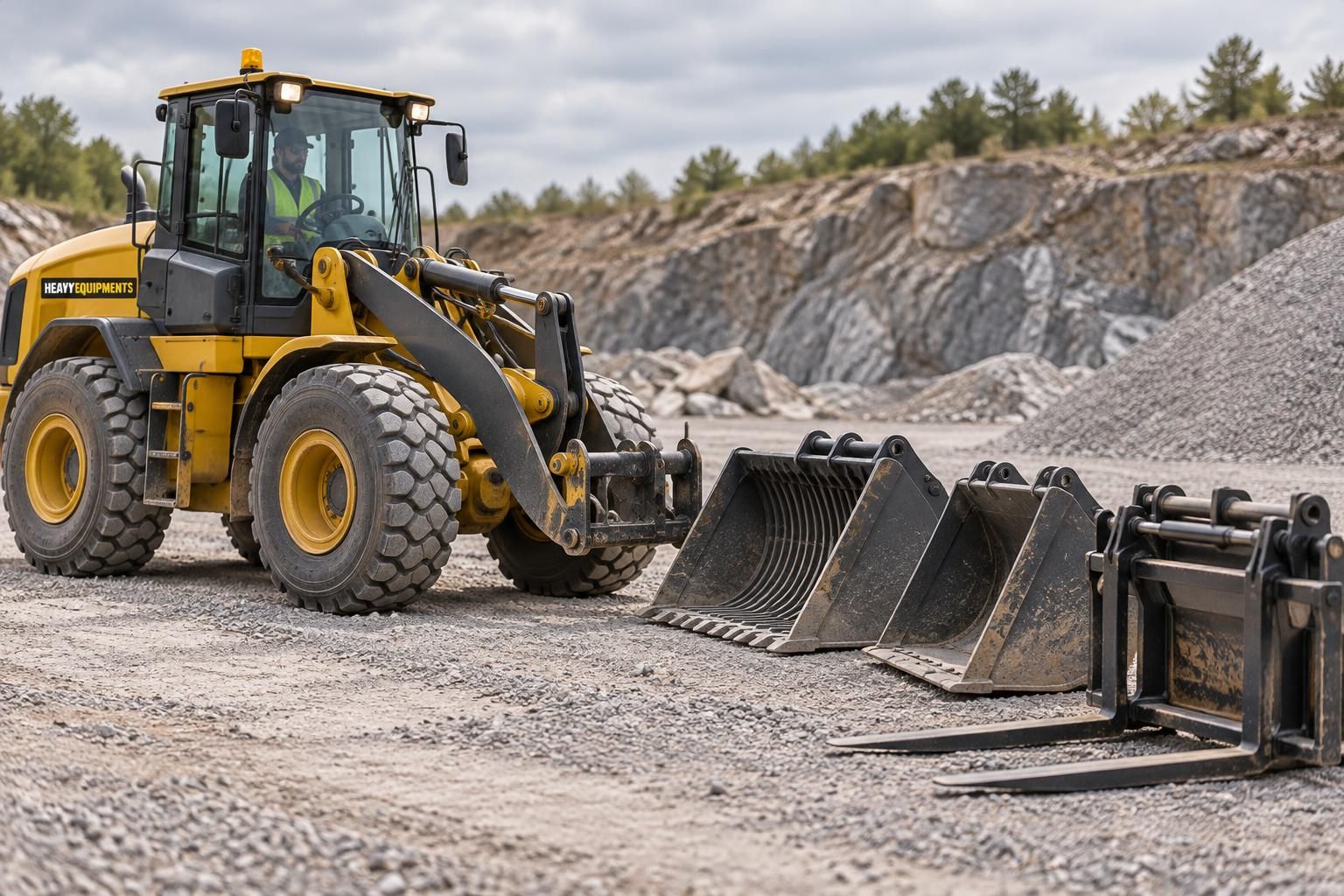
- General purpose GP, the everyday choice for soil, aggregates, and stockpiles. Typically fitted with bolt-on cutting edges or teeth for versatility.
- Heavy duty or rock buckets use a reinforced shell and side cutters to handle abrasion and impact in quarry and shot rock. Often armored with wear segments and heel plates.
- Light material styles have larger bodies and spill guards for low-density material like mulch, coal, or snow, aimed at moving more volume per pass without overloading the machine.
- High dump uses a scissor style dump frame that lifts the bucket floor higher at dump-out, useful for loading high sided trucks or hoppers with lower reach loaders.
- Side dump buckets tip to the side for trench backfill, roadwork, or tight plants where straight ahead dumping is not possible.
- 4 in 1 or multipurpose uses a clamshell design for dozing and clamping along with grading in utility and site work, often seen on compact wheel loaders where one tool must do many jobs.
Across all styles, pay attention to edge type (bolt-on edge vs. teeth), wear protection, and spill guards. These choices affect fill factor and material retention, plus life cycle cost.
How to think about bucket capacity
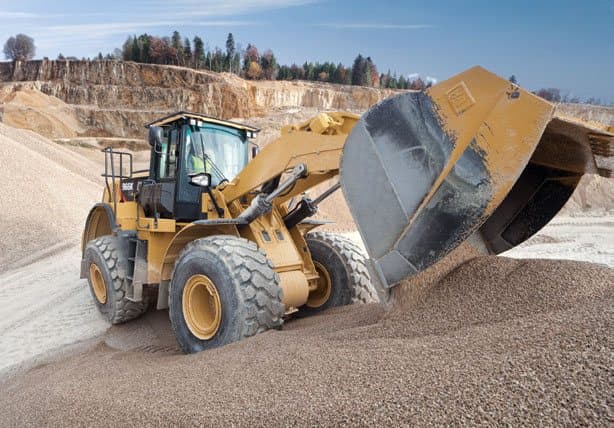
Bucket capacity should match material density, your loader’s stability and hydraulic power, and the target payload per pass. As a reference point, the Caterpillar 950 GC is specified with a 3.1 to 3.3 m³ bucket capacity. That is a typical mid-size wheel loader pairing for general-purpose aggregates. Lighter or heavier materials, or different job goals (e.g., keep-up loading vs. precise batching), will push you to smaller or larger buckets.
When sizing capacity:
- Start with the loader’s limits. Operating weight and tipping capacity if published, plus power, frame what the machine can safely and productively carry without excessive cycle times or spillage.
- Match bucket volume to material density. Denser material needs less volume to hit the same tonnage. Stay conservative when densities vary or moisture increases.
- Consider fill factor and pile conditions. The real payload depends on how easily the bucket fills in your stockpile, not just its struck or heaped rating.
- Keep the haul units in mind. Size to cleanly divide truck or bin capacity in whole passes wherever possible.
If you are stepping up from a compact wheel loader into mid-size iron, the jump in power and weight often supports a larger bucket. For example, models in the 70 to 110 kW range generally pair with smaller buckets than machines around 170 to 200 kW, but always confirm against the manufacturer’s guidance and site material. When in doubt, trial a demo bucket and verify cycle times and stability at full lift and turn.
Couplers and quick attach basics
Couplers let you change tools fast and standardize attachments across a fleet. The tradeoffs are added weight and a small loss in breakout force versus pin-on mounting. Key concepts:
- Pin on and dedicated couplers. Pin on buckets maximize performance but slow changeovers. Dedicated quick couplers, mechanical or hydraulic, swap tools quickly and are common where multiple attachments are used daily.
- Pattern and compatibility. Several common patterns exist in the market, often identified by brand families or industry patterns, and some regions use standardized quick coupler geometries. Always verify the coupler pattern on your loader against the bucket’s hook and pin geometry before buying.
- Hydraulic and manual styles. Hydraulic couplers speed changeovers from the cab, while manual versions reduce cost and weight but require ground work.
- Locking and visibility. Positive locking indicators and regular inspection of wedges and pins, plus bushings, are essential. Coupler wear translates directly into bucket tip movement and poor grading control.
- Performance impact. Couplers and adapters shift the load center. Expect some effect on breakout and dump clearance, so check your most demanding tool, typically the heaviest bucket you plan to run.
Spec snapshots to frame bucket and coupler choices
The table below compiles verified power and weight plus available load related specs across a range of loaders, compact up through production machines. Use it to benchmark what bucket sizes and coupler setups may be appropriate for your class of loader. Where a specific figure is not published, we leave it blank.
| Model | Power (kW (hp)) | Operating weight (kg (lbs)) | Tipping capacity (kg (lbs)) | Bucket capacity (m³) |
|---|---|---|---|---|
| Caterpillar 950 GC | 168 () | 18,500 () | , | 3.1, 3.3 |
| Caterpillar 938F | 104.4 (140) | 13031.7 (28730) | , | , |
| Caterpillar 970F | 186.4 (250) | 23251.1 (51260) | , | , |
| Caterpillar IT28G | , | 12133.6 (26750) | , | , |
| Komatsu WA200-5 | 91.7 (123) | 9471.0 (20880) | , | , |
| Komatsu WA270-7 | 111.0 (148.9) | , | , | , |
| Komatsu WA4706 | 202.8 (272) | 22960.8 (50620) | , | , |
| Komatsu WA4705H | 202.0 (270.9) | 23818.1 (52510) | 20643.0 (45510) | , |
| Volvo LM840 | 82.0 (110) | 9570.8 (21100) | 4218.4 (9300) | , |
| Volvo LM841 | 83.5 (112) | 9870.2 (21760) | 4300.1 (9480) | , |
| Volvo LM845 | 83.5 (112) | 9548.1 (21050) | 5901.2 (13010) | , |
| Volvo LM846 | 89.5 (120) | 10201.3 (22490) | 6799.3 (14990) | , |
| John Deere 344K | 72.3 (97) | 8509.4 (18760) | , | , |
| John Deere 544D | 85.8 (115) | 10278.4 (22660) | 7352.7 (16210) | , |
| Liebherr L514 | 73.1 (98) | 7720.1 (17020) | 5674.4 (12510) | , |
| Liebherr L524 | 90.2 (121) | 10400.9 (22930) | 7502.4 (16540) | , |
| Liebherr L574 | 197.6 (265) | 24249.0 (53460) | 18347.8 (40450) | , |
| Liebherr L576 | 200.1 (268.3) | 24258.1 (53480) | , | , |
Reading the table:
- Compact wheel loader range. Machines like the Liebherr L514 and John Deere 344K sit in the ~70 to 75 kW class with operating weights under 9,000 kg for agile site work. Buckets trend smaller, and multipurpose or light-material styles are common.
- Mid size all rounders. Loaders such as the Caterpillar 938F and Komatsu WA200-5 offer more power and stability for 2 to 3 shift sites, with broader bucket options and quick coupler usage.
- Production loaders. Higher power units such as the Caterpillar 970F and Komatsu WA470 series, plus Liebherr L574 or L576, support larger buckets and heavier duty designs for quarry and loadout.
Practical tips for matching buckets and couplers
- Confirm the coupler pattern first. Before buying used or aftermarket buckets, verify the coupler geometry on your loader and the attachment. Labeling can be ambiguous across brands and years.
- Mind the weight of adapters. Coupler adapters and longer floor buckets add weight and shift load centers, check against tipping capacity and lift charts for your machine.
- Standardize where you can. If you run mixed brands, consider aligning on one quick attach pattern per size class to maximize attachment sharing.
- Protect edges and heels. Bolt-on edges and wear heels are cheaper to replace than base metal. They also maintain bucket geometry and fill performance over time.
- Audit actual payload. If you use onboard scales, spot check against target payloads and adjust bucket selection or fill technique to hit pass counts into trucks.
- Service the coupler. Keep pins and wedges, along with latches, clean and within wear limits; a sloppy coupler ruins grade work and can become a safety risk.
Next steps to take
Dial in the right setup. Browse loader specifications by brand and size in our specs, line up two or more models in our side-by-side comparison, and explore compatible tools in attachments. If you are sourcing gear, check current for-sale listings, short-term rentals, and hard-to-find parts. Bring the bucket and coupler choices together and validate against your material to see the payoff in faster cycles and cleaner loads.