Skid Steer Brush Cutters Matched to Flow, Case Drain and Weight
Match a skid steer brush cutter to your machine’s hydraulic flow, case drain needs, and carrier weight. Includes a spec table for popular models.
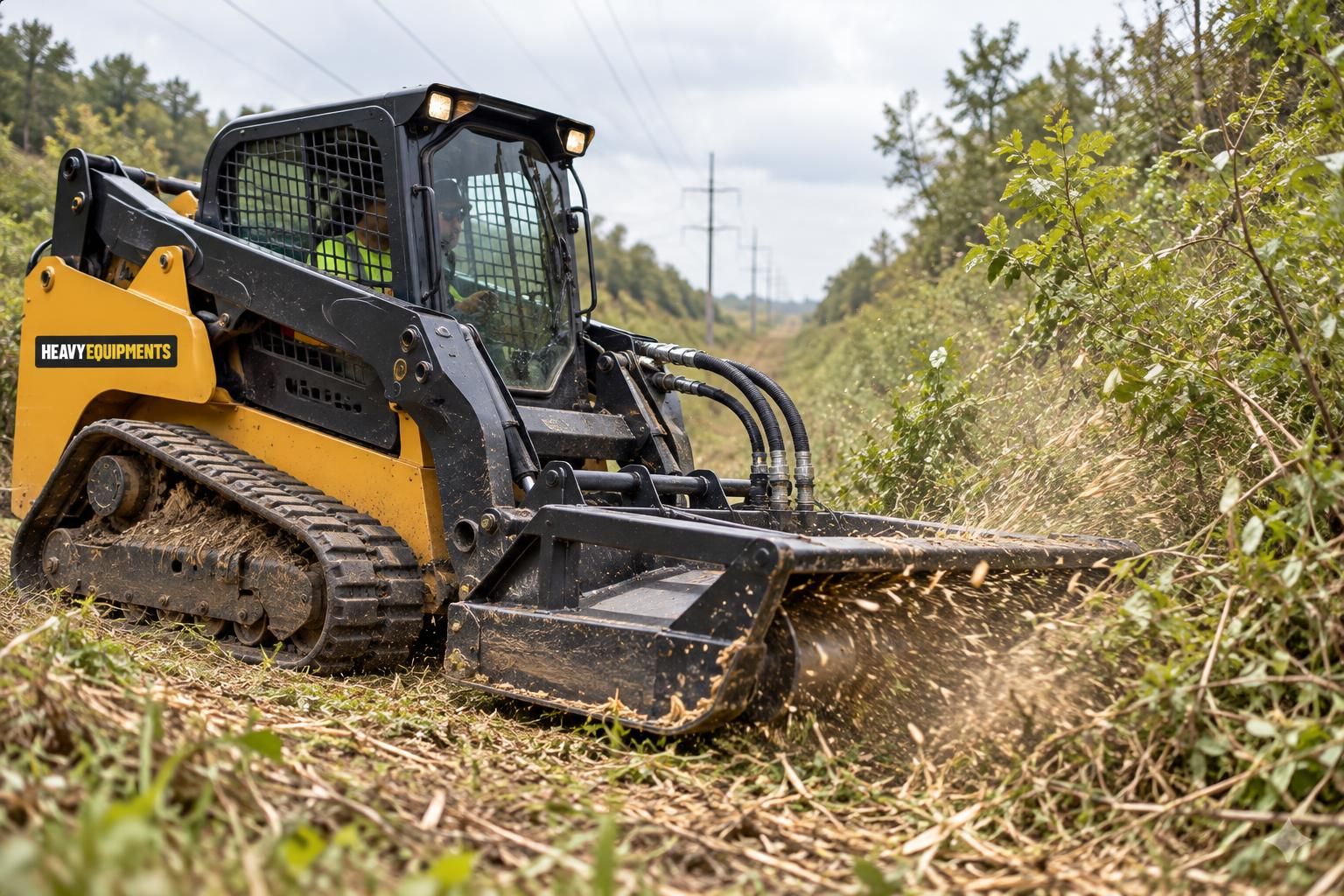
Brush cutting looks simple until you hook up the head and discover your skid steer can’t keep it spinning, runs hot, or feels light in the rear. The right skid steer brush cutter starts with three things you can confirm before you buy or rent: hydraulic flow, whether a case drain line is required, and whether your carrier has the weight and stability to control the head. Use the guidance and the comparison table below to narrow your match, then verify the cutter’s requirements with the manufacturer.
The three pillars of a good match
Before you focus on deck style or cutting teeth, get these right:
- Hydraulic flow powers the cutter. The attachment will specify required flow and pressure, and your skid steer must meet or exceed that. Flow specs are model specific. Two machines with similar horsepower may have different pump outputs. For example, the older John Deere 125 lists a pump capacity of 56.8 LPM (15.0 GPM). Most other machines below don’t publish pump capacity here, so confirm in the operator’s manual or data plate.
- A case drain, also called a return to tank, protects the motor on many hydraulic cutters and mulchers by safely returning excess oil. If the head calls for a case drain, your machine must have the dedicated low-pressure return port and hose, not just the two standard couplers.
- Carrier weight and stability keep the head planted. Operating weight, tipping load, and rated operating capacity are your stability clues. Heavier, higher ROC machines tend to manage larger, higher inertia heads with less porpoising and better slope control.
Hydraulic flow checks and why it matters
Brush cutters and mulchers are matched to hydraulic output. A mismatch shows up as slow blade speed, stalling in heavier material, or overheating. To avoid that:
- Find your machine’s pump capacity (LPM or GPM) and auxiliary circuit rating. If it isn’t on the data plate or in our model specs, look it up in the OEM manual or on the machine’s auxiliary hydraulics placard.
- Compare to the cutter’s required flow. If the head has a “minimum” and “optimal” flow, expect noticeably better performance at the higher end.
- Do not use horsepower as a proxy for flow. For instance, the Bobcat S650 and Kubota SSV75 both list around 74 HP, but pump specs can differ by model and options. Always verify actual auxiliary flow.
If you only have basic auxiliary hydraulics on an older machine, look for cutter heads designed for that output. Where available, factory high performance or optional auxiliary circuits are often paired with higher demand cutters and mulchers. Confirm before you commit.
Case drain and when it is required
A case drain (also called a third line or return to tank) allows low-pressure case leakage oil from the hydraulic motor to return directly to the tank. Many hydraulically driven cutters and mulchers specify a case drain to prevent seal failure and heat buildup. If your head requires it:
- Make sure your carrier has a dedicated case drain port and the correct coupler. This is separate from the two standard quick couplers.
- Route and connect lines exactly as the attachment OEM instructs to avoid backpressure in the case line.
- Keep filters and screens clean. A restricted return path overheats the system and can damage the motor.
If your machine lacks a case drain but the head requires one, consult your dealer or a qualified hydraulic shop about adding the proper return to tank kit.
Carrier weight ROC and lift path for brush cutting
Once flow and case drain are sorted, make sure the machine has the mass and lift performance to control the head safely:
- Operating weight is your first stability indicator. Heavier machines like the John Deere 332G (4540 kg / 10000 lbs) or Bobcat S770 (4161.7 kg / 9175 lbs) typically hold a cutter steadier on slopes and when the head spools up.
- Tipping load and rated operating capacity (50% tipping) indicate how much the loader can safely handle without becoming light. For example, the Caterpillar 272D lists a 50% ROC of 1451.5 kg (3200 lbs) and a 2903.0 kg (6400 lbs) tipping load, use figures like these to gauge control with heavier heads.
- Lift design (radial vs. vertical) is not a deal breaker for mowing, but vertical lift machines can make it easier to load debris into trucks, while radial lift machines often have strong mid-height performance. Choose based on your job mix (mowing only vs. mowing plus loading).
How popular carriers stack up for brush cutter duty
Use the table to compare horsepower, operating weight, and stability metrics across common machines that often run a skid steer brush cutter. Match these traits to your terrain and attachment type, then confirm hydraulic flow and case drain needs with the cutter manufacturer.
Skid steer specs that influence brush cutter selection
| Model | Lift design | Horsepower | Operating weight | ROC (50% tipping) | Tipping load | Hydraulic pump capacity |
|---|---|---|---|---|---|---|
| Bobcat S595 | Vertical | 55.2 kW (74.0 HP) | 3081.3 kg (6793 lbs) | 997.9 kg (2200 lbs) | 1995.8 kg (4400 lbs) | N/A |
| Bobcat S650 | Vertical | 55.4 kW (74.3 HP) | 3777.1 kg (8327 lbs) | 1220.2 kg (2690 lbs) | 2440.3 kg (5380 lbs) | N/A |
| Bobcat S750 | Vertical | 63.4 kW (85.0 HP) | 4033.8 kg (8893 lbs) | 1451.5 kg (3200 lbs) | 2903.0 kg (6400 lbs) | N/A |
| Bobcat S770 | Vertical | 68.6 kW (92.0 HP) | 4161.7 kg (9175 lbs) | 1519.5 kg (3350 lbs) | 3039.1 kg (6700 lbs) | N/A |
| Caterpillar 242D | Vertical | 55.4 kW (74.3 HP) | 3367.5 kg (7424 lbs) | 975.2 kg (2150 lbs) | 1950.4 kg (4300 lbs) | N/A |
| Caterpillar 246D | Radial | 55.4 kW (74.3 HP) | 3367.5 kg (7424 lbs) | 975.2 kg (2150 lbs) | 1950.4 kg (4300 lbs) | N/A |
| Caterpillar 272D | Vertical | 73.1 kW (98.0 HP) | 3742.1 kg (8250 lbs) | 1451.5 kg (3200 lbs) | 2903.0 kg (6400 lbs) | N/A |
| John Deere 332G | Vertical | 74.6 kW (100.0 HP) | 4540 kg (10000 lbs) | 1701 kg (3750 lbs) | 3269 kg (7200 lbs) | N/A |
| John Deere 328E | Vertical | 64.1 kW (86.0 HP) | 3978.0 kg (8770 lbs) | 1270.1 kg (2800 lbs) | 2540.1 kg (5600 lbs) | N/A |
| John Deere 240 | Vertical | 39.5 kW (53.0 HP) | 2796.4 kg (6165 lbs) | 680.4 kg (1500 lbs) | 1542.2 kg (3400 lbs) | N/A |
| John Deere 125 | Vertical | 27.6 kW (37.0 HP) | 2458 kg (5420 lbs) | 601 kg (1325 lbs) | 1202 kg (2650 lbs) | 56.8 LPM (15.0 GPM) |
| Case SR160 | Radial | 44.7 kW (60.0 HP) | 2499.3 kg (5510 lbs) | 725.7 kg (1600 lbs) | 1451.5 kg (3200 lbs) | N/A |
| Case SV185 | Vertical | 44.7 kW (60.0 HP) | 2950 kg (6500 lbs) | 840 kg (1850 lbs) | 1678 kg (3700 lbs) | N/A |
| Case 95XT | Radial | 63.4 kW (85.0 HP) | 4105.0 kg (9050 lbs) | 1428.8 kg (3150 lbs) | 2857.6 kg (6300 lbs) | N/A |
| Kubota SSV65 | Vertical | 47.7 kW (64.0 HP) | 3197.8 kg (7050 lbs) | 884.5 kg (1950 lbs) | 1769.0 kg (3900 lbs) | N/A |
| Kubota SSV75 | Vertical | 55.4 kW (74.3 HP) | 3819.8 kg (8421 lbs) | 1220.2 kg (2690 lbs) | 2440.0 kg (5379 lbs) | N/A |
Machines that pair well with common heads
Attachment makers publish the definitive match guidance, but the specs above can steer your shortlist:
- For lighter, standard flow friendly cutters, look at machines in the roughly 40 to 60 HP bracket with modest ROC, such as the Case SR160, John Deere 240, or Kubota SSV65. These can be a fit for lighter brush and maintenance mowing, but verify flow first.
- For mid range cutters, models around the mid 70 HP class with higher ROC provide a stability margin for denser material, like the Bobcat S650, Bobcat S595, Cat 242D, Cat 246D, or Kubota SSV75.
- Higher demand cutters and mulchers suit heavier, higher inertia heads, so shortlist heavier, higher ROC carriers, such as Cat 272D, Bobcat S750, Bobcat S770, Deere 328E, or Deere 332G. Then verify that your auxiliary hydraulics meet the head’s flow and case drain requirements.
Setup checklist before you cut
- Confirm hydraulic flow and pressure against the attachment’s requirements. If your machine’s pump capacity isn’t listed above, pull it from the manual or data plate.
- Verify case drain if the head calls for it. Make sure the third line is plumbed to a low-pressure return.
- Check coupler sizes and hose routing to prevent chafing when the arms are raised and the head is angled.
- Balance and ballast matter. If the machine feels light, consider counterweight options approved by the OEM.
- Guarding and debris control are essential. Use appropriate front door, side window, and belly guarding for brush and mulching work per your safety plan.
- Cooling and maintenance need attention. Clean coolers and screens frequently. Brush work is dusty, and airflow keeps temperatures in check.
Next steps to take
Start by comparing carrier specs side by side in our spec compare tool and browsing the full skid steer database. When you’ve dialed in the right machine for your brush cutter or mulcher, see what’s for sale, check rentals for short term needs, and source attachments and parts compatible with your setup.