How to Size Mini Skid Steer Attachments by Flow and Weight
A practical guide to matching mini skid steer trenchers, brush cutters, augers, and power rakes by focusing on hydraulic flow, pressure, and machine weight or ROC. Includes examples from full size skid steers to show how margins stack up.
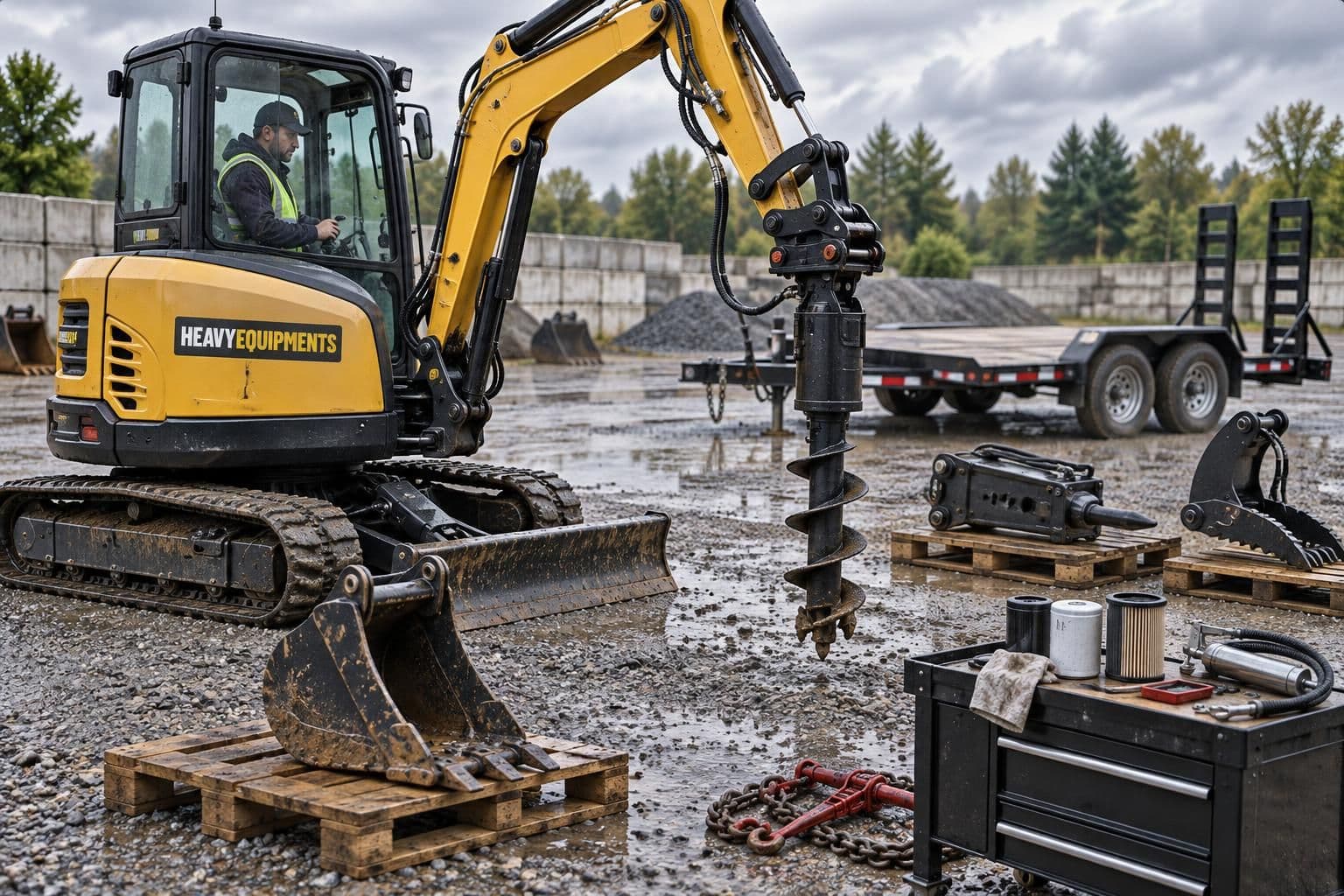
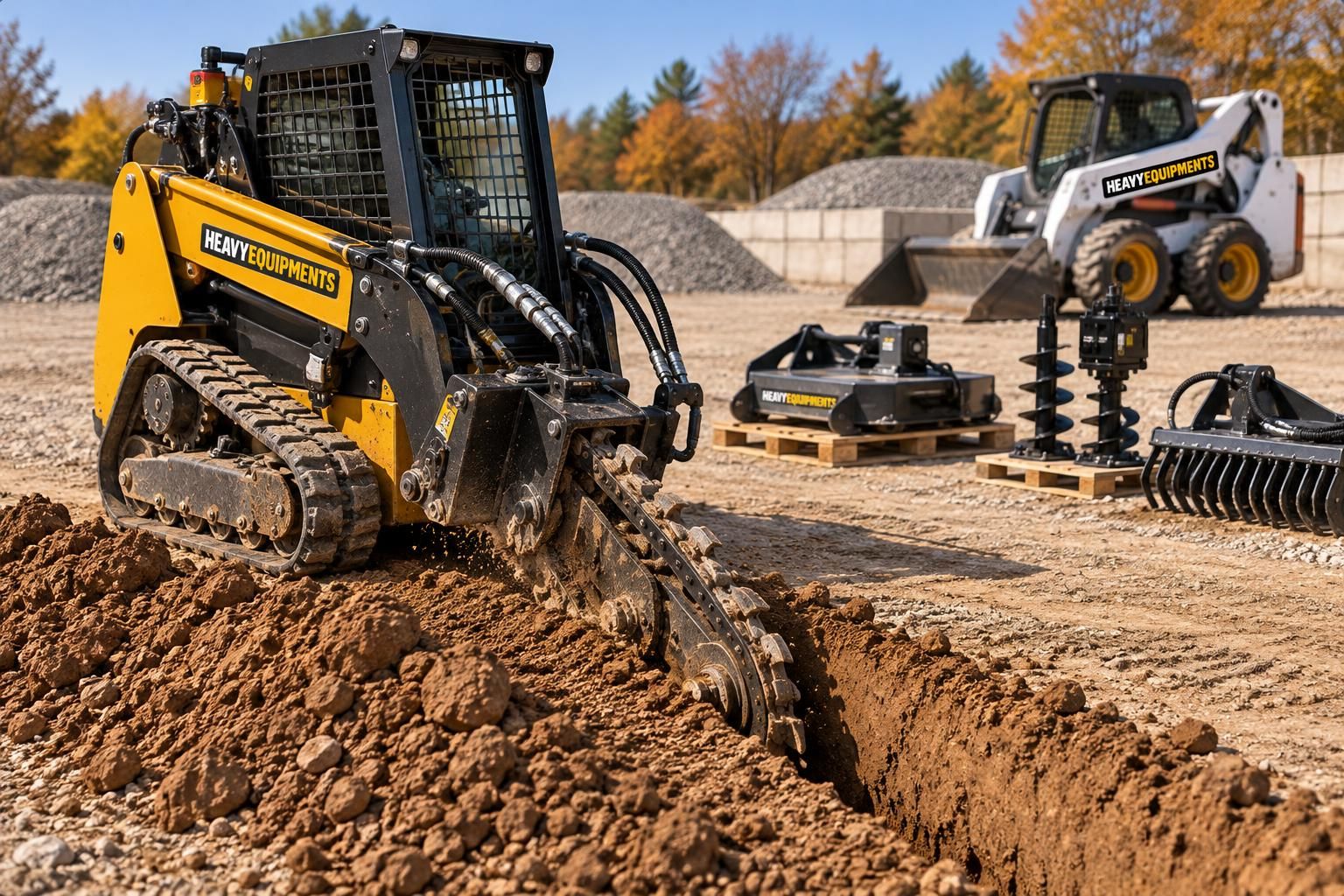
Mini skid steer attachments can turn a compact platform into a trenching, cutting, augering, or grading tool that punches above its weight. With smaller hydraulic systems and lighter chassis, matching the attachment to the carrier is critical. This guide walks through how to size trenchers, a skid steer brush cutter, augers, and a Harley rake for skid steer use on mini platforms (focusing on hydraulic flow/pressure and weight). Where useful, we show example ratings from full-size skid steers so you can see how your margins change as machines get smaller.
Machine weight ROC and lift path
For mini skid steer attachments, your two biggest constraints are:
- Weight and rated operating capacity (ROC). Attachments and material loads quickly consume a mini’s 35% or 50% tipping ratings. Even full-size models can run out of margin if you overhang heavy tools far forward or work on slopes. Always check both ROC ratings when available, the tipping load, and the operating weight.
- Hydraulics. Flow (L/min or GPM), pressure (bar or PSI), and whether the tool needs continuous flow or a case drain. Minis often have lower flow and pressure than full-size units.
Lift path also matters. Radial-lift machines favor digging and pushing with strong mid-lift performance. Vertical-lift designs tend to hold capacity higher for loading and pallet work, useful if your attachment’s center of gravity sits forward and high.
To visualize how capacity scales, consider these full-size examples (your mini’s numbers will be lower, so plan with extra margin): the Bobcat S595 lists 997.9 kg (2200 lbs) at 50% tipping and 748.4 kg (1650 lbs) at 35% tipping, with a tipping load of 1995.8 kg (4400 lbs). The Case SR210 shows 952.5 kg (2100 lbs) at 50% and a 1905.1 kg (4200 lbs) tipping load. An older, smaller machine like the Case 1835 Diesel is rated 544.3 kg (1200 lbs) at 50% and 385.6 kg (850 lbs) at 35%, a reminder of how quickly capacity tightens on smaller platforms. You can search and verify ratings on our specs pages.
Hydraulic realities for mini skid steer attachments
Most trenchers, brush cutters, augers, and power rakes can run on “standard flow,” but many have high-flow versions or torque-heavy options. Minis typically favor standard-flow tools and moderate widths/diameters. Keep these rules of thumb in mind:
- Match flow and pressure to the attachment’s spec sheet. Too little flow stalls performance; too much can overheat or damage the motor.
- Brush cutting and power raking are continuous-load tasks, so cooling capacity matters more on small machines.
- Some motors require a case drain third line, verify before you hook up.
- Confirm quick-coupler size/type and any 14-pin/aux controls the tool needs.
When in doubt, pick the lighter, lower-flow version of an attachment for a mini and accept a narrower cut or slower production as the tradeoff for control and longevity.
Trenchers torque chain and stability
A trencher’s productivity is governed by hydraulic torque and chain speed, but on minis you will often size down width and depth to keep flow and weight in check. Practical tips:
- Chain width and depth. Narrower and shallower chains need less power and weigh less at the nose of the machine, helping stability.
- Spoil auger and crumber. Useful features, but verify added weight against your 35% ROC when working on uneven ground.
- Track speed. Trenching favors slow, steady travel. Many operators creep to prevent chain stall and reduce shock loads on a small hydraulic system.
Compare your mini’s ratings to larger machines to see the margin gap. For example, the Bobcat S650 carries a 1220.2 kg (2690 lbs) 50% ROC and 2440.3 kg (5380 lbs) tipping load, well above a compact unit, so a trencher that feels balanced on an S650 may be nose-heavy on a mini.
Brush cutters inertia deck style and overhang
Choosing a skid steer brush cutter for a mini means balancing deck width with inertia demands and overhang. Consider:
- Deck width and weight. Wider decks weigh more and sit farther forward. On minis, that quickly eats into the 35% ROC, especially with grass and brush building under the deck.
- Open front and closed deck. Open-front cutters tackle saplings but can transmit higher shock loads. Closed decks hold material longer and may have steadier load on small hydraulics.
- Direct drive and gear or chain drive. Direct drives are common; some designs rely on flywheel mass for smoothing power demand, verify your mini’s ability to spin up without stalling.
As a sanity check, note how much capacity full-size loaders bring. A vertical-lift unit like the Bobcat S750 shows 1451.5 kg (3200 lbs) at 50% tipping and a 2903.0 kg (6400 lbs) tipping load, giving ample headroom for a heavy cutter. On a mini, choose a narrower, lighter deck and keep blades sharp to reduce power draw.
Augers torque needs and bit selection
Augers for minis work best with moderate bit diameters and shorter extensions. Key points:
- Planetary drives. Higher torque at lower speed is handy for clay and roots when flow is limited.
- Bit and extension weight. Add the drive head, bit, and any extension to your ROC math. Keep the center of gravity close to the coupler.
- Downforce. Minis have less machine weight to push; sharp teeth and the right flighting help more than brute force.
Older, lighter machines highlight the constraint: the Case 1835 Diesel is limited to 544.3 kg (1200 lbs) at 50% tipping. Mini units are similar or lower, so scale bit size accordingly.
Power rakes Harley rakes width angle and traction
A Harley rake for skid steer use on a mini should match the machine’s overall width and flow. Wider drums and hydraulic angle kits add weight and duty cycle. Keep in mind:
- Match width to machine. Do not exceed your track/tire width by much, or you will fight traction and stability.
- Angle and windrowing. Angling the drum shifts the material load to one side, on lighter machines that can reduce stability on slopes.
- Continuous duty. Power raking is sustained load, watch hydraulic temperatures and take cool-down passes if needed.
How full size ROC compares for context
The table below shows select full-size skid steer specs to illustrate how weight and capacity scale. Use it to benchmark how much margin you give up as you move to a mini; then size your attachments conservatively.
| Model | Lift design | Horsepower | Operating weight | ROC 50% | ROC 35% | Tipping load |
|---|---|---|---|---|---|---|
| Bobcat S595 | Vertical | 55.2 kW (74.0 HP) | 3081.3 kg (6793 lbs) | 997.9 kg (2200 lbs) | 748.4 kg (1650 lbs) | 1995.8 kg (4400 lbs) |
| Bobcat S650 | Vertical | 55.4 kW (74.3 HP) | 3777.1 kg (8327 lbs) | 1220.2 kg (2690 lbs) | , | 2440.3 kg (5380 lbs) |
| Bobcat S750 | Vertical | 63.4 kW (85.0 HP) | 4033.8 kg (8893 lbs) | 1451.5 kg (3200 lbs) | 1102.2 kg (2430 lbs) | 2903.0 kg (6400 lbs) |
| Kubota Ssv65 | Vertical | 47.7 kW (64.0 HP) | 3197.8 kg (7050 lbs) | 884.5 kg (1950 lbs) | 612.3 kg (1350 lbs) | 1769.0 kg (3900 lbs) |
| Case SR210 | Radial | 55.2 kW (74.0 HP) | 3161.5 kg (6970 lbs) | 952.5 kg (2100 lbs) | , | 1905.1 kg (4200 lbs) |
| Case 1835 Diesel | Radial | 25.4 kW (34.0 HP) | 2063.8 kg (4550 lbs) | 544.3 kg (1200 lbs) | 385.6 kg (850 lbs) | 1088.6 kg (2400 lbs) |
| Case Sv280 | Vertical | 55.2 kW (74.0 HP) | 3669.6 kg (8090 lbs) | 1270.1 kg (2800 lbs) | , | 2540.1 kg (5600 lbs) |
Note how the heavier machines carry significantly higher ROC and tipping loads. When you downsize to a mini, treat those figures as an upper bound, and keep attachment selection lean.
Quick compatibility checklist
- Attachment weight plus expected material load stays within your machine’s 35% ROC, especially for work on slopes or with overhanging tools.
- Hydraulic flow and pressure match the tool’s range; continuous-duty tools may need cooldown intervals on minis.
- Case drain requirement and aux coupler size/type verified.
- Electrical controls for angle, reverse, or variable speed are supported by the carrier.
- Lift path. Vertical-lift for higher carry, radial for digging/pushing; choose accordingly.
- Visibility and overhang. Keep center of gravity close; shorter booms and narrower tools help.
Next steps for attachment sizing
Confirm your machine’s ratings on our specs pages, line up two or three candidate attachments, then use compare to sanity check capacities side by side. When you are ready to outfit the fleet, browse attachments, check for sale listings, line up rentals for peak season, and source parts to keep everything turning. With minis, flow and weight margins are tight, so pick lighter, narrower tools, and you will get dependable production without fighting stability or hydraulics.