Harley Rakes for Skid Steers, Setup, Sizing and Flow
How to pick and set up a Harley rake for skid steers, including drum width, hydraulic flow, and machine pairing. Includes a spec table to match rakes to your fleet.
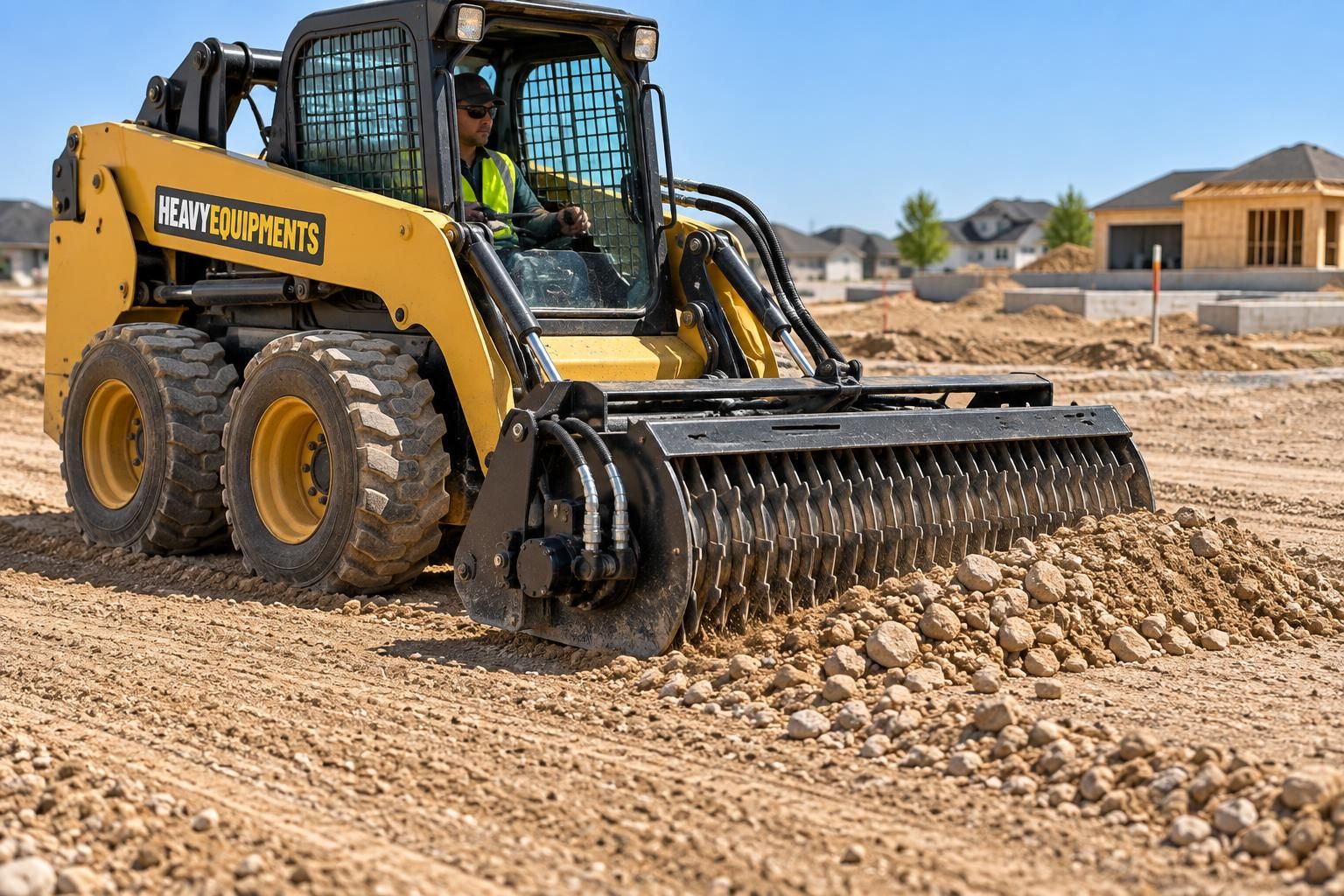
A Harley rake turns bumpy, debris-littered ground into a smooth, seed-ready surface fast. To get that “one-pass” finish, you need the right match between drum width, hydraulic flow, and your skid steer’s weight and power. This guide explains how to pick a Harley rake for skid steers (and mini skid steer attachments), how to pair it to your loader, and what to check on setup so you spend more time grading and less time fighting the machine.
How a Harley rake works and why pairing matters
A Harley rake’s rotating drum with carbide teeth pulverizes clods, sheds rocks and roots to the side, and leaves a groomed surface. The attachment’s effectiveness depends on two things your loader contributes:
- Hydraulic flow and pressure to keep drum speed up under load.
- Machine stability, weight, and power to hold grade and maintain ground speed.
Under-size the loader and you will stall or crawl. Over-size the rake and you will fight stability and leave washboard. Getting the combination right is the difference between three passes and one.
Drum width and features for your ground and machine
- Pick a drum that is at least as wide as your tire stance or track width so you are finishing the full path. On soft soils, a slightly wider drum helps overlap and avoid ridge lines. On tight sites, a narrower drum is easier to maneuver.
- Rakes that angle left or right can cast debris to one side and leave a cleaner mat. Fixed models are simpler but require more passes to manage spoils.
- Carbide teeth handle mixed soils and small rock well. Heavier patterns are better for virgin ground, lighter patterns suit finish work and topdressing.
- Front casters keep the drum consistent over dips and crowns, improving finish quality on turf prep.
Hydraulic flow standard and high flow guide
Harley rakes come in standard-flow and high-flow variants. Standard-flow models pair with most mid-size loaders, high-flow rakes are built for aggressive reclamation, heavy spoils, or wide drums. The key is to match the rake’s requirement to your skid steer’s auxiliary rating:
- Check the plate or manual for the auxiliary hydraulic rating on your machine. For example, the John Deere 125 lists Pump Capacity at 56.8 LPM (15.0 GPM), a standard-flow figure that suits many general-purpose rakes sized for smaller loaders.
- High-flow packages, if installed on your loader, support larger or more aggressive drums. If you do not see a high-flow switch, additional couplers, or a decal, assume standard-flow and size the rake accordingly.
- Many rakes require a case-drain line. Confirm your coupler set matches the attachment’s hoses before delivery.
Bottom line: choose a rake built for your machine’s flow. A standard-flow drum on a standard-flow loader is better than an oversized, high-flow drum you cannot keep spinning.
Match the rake to machine size and power
Power, operating weight, and tipping load affect how confidently you can keep the drum engaged while holding grade. Heavier, higher-ROC loaders carry wide drums better on slopes and in rocky soils. Lighter loaders pair well with narrower drums for topsoil prep and lawn installs.
Use the spec snapshot below to position your fleet. It lists horsepower, Rating Operating Capacity at 50% tipping (for apples-to-apples payload comparison), operating weight, and tipping load. If you are on the fence between two rake widths, this table helps you decide which loaders in your yard have the mass and power to run the bigger drum.
| Model | Horsepower | ROC (50% tipping) | Operating weight | Tipping load |
|---|---|---|---|---|
| Bobcat S595 | 55.2 kW (74.0 HP) | 997.9 kg (2200 lbs) | 3081.3 kg (6793 lbs) | 1995.8 kg (4400 lbs) |
| Bobcat S650 | 55.4 kW (74.3 HP) | 1220.2 kg (2690 lbs) | 3777.1 kg (8327 lbs) | 2440.3 kg (5380 lbs) |
| Bobcat S750 | 63.4 kW (85.0 HP) | 1451.5 kg (3200 lbs) | 4033.8 kg (8893 lbs) | 2903.0 kg (6400 lbs) |
| Caterpillar 242D | 55.4 kW (74.3 HP) | 975.2 kg (2150 lbs) | 3367.5 kg (7424 lbs) | 1950.4 kg (4300 lbs) |
| Caterpillar 246D | 55.4 kW (74.3 HP) | 975.2 kg (2150 lbs) | 3367.5 kg (7424 lbs) | 1950.4 kg (4300 lbs) |
| Caterpillar 262B | 61.1 kW (82.0 HP) | 1224.7 kg (2700 lbs) | 3565.0 kg (7859 lbs) | 2449.4 kg (5400 lbs) |
| Caterpillar 272D | 73.1 kW (98.0 HP) | 1451.5 kg (3200 lbs) | 3742.1 kg (8250 lbs) | 2903.0 kg (6400 lbs) |
| John Deere 240 | 39.5 kW (53.0 HP) | 680.4 kg (1500 lbs) | 2796.4 kg (6165 lbs) | 1542.2 kg (3400 lbs) |
| John Deere 328E | 64.1 kW (86.0 HP) | 1270.1 kg (2800 lbs) | 3978.0 kg (8770 lbs) | 2540.1 kg (5600 lbs) |
| John Deere 332G | 74.6 kW (100.0 HP) | 1701 kg (3750 lbs) | 4540 kg (10000 lbs) | 3269 kg (7200 lbs) |
| Kubota SSV65 | 47.7 kW (64.0 HP) | 884.5 kg (1950 lbs) | 3197.8 kg (7050 lbs) | 1769.0 kg (3900 lbs) |
| Kubota SSV75 | 55.4 kW (74.3 HP) | 1220.2 kg (2690 lbs) | 3819.8 kg (8421 lbs) | 2440.0 kg (5379 lbs) |
| Case SR160 | 44.7 kW (60.0 HP) | 725.7 kg (1600 lbs) | 2499.3 kg (5510 lbs) | 1451.5 kg (3200 lbs) |
| Case 90XT | 63.4 kW (85.0 HP) | 1111.3 kg (2450 lbs) | 4059.7 kg (8950 lbs) | 2222.2 kg (4900 lbs) |
| Case 95XT | 63.4 kW (85.0 HP) | 1428.8 kg (3150 lbs) | 4105.0 kg (9050 lbs) | 2857.6 kg (6300 lbs) |
How to use the table
- Light class loaders such as the John Deere 240 and Case SR160 suit narrower, standard-flow rakes for lawn installs and topsoil prep.
- Mid class machines such as the Bobcat S595, Bobcat S650, Caterpillar 242D or 246D, and Kubota SSV65 handle general site cleanup and seedbed work with mid-width drums.
- Heavy class models like the Bobcat S750, Caterpillar 262B or 272D, John Deere 328E or 332G, Kubota SSV75, and Case 90XT or 95XT carry wider drums confidently and keep production up in mixed soils.
Setup tips that speed up grading
- Run the loader in float where recommended so the drum follows terrain. Use gauge wheels to keep cross-slope consistent.
- Angle a few degrees to build a windrow on the high side. Straighten for a final pass to leave a clean mat.
- If the drum starts to chatter or stall, slow the travel speed or take a shallower bite. Maintain steady RPM and let the drum do the work.
- Pneumatic tires can shed mud and are gentle on turf, tracks spread ground pressure and excel on soft subgrades. Either works. Set expectations and drum aggressiveness accordingly.
- Rake in lifts on rocky ground. Use a bucket or grapple to remove windrows between passes so you are not recirculating rock.
Mini skid steer attachments for tight access
If you are working courtyards, pool installs, or backyards with narrow gates, mini skid steer attachments sized as Harley rakes can be the fastest way to finish. Keep in mind:
- Choose a drum that fits the tightest access and matches your mini’s stance for a full-finish pass.
- Minis typically run standard-flow hydraulics. Pick a standard-flow rake and verify couplers and case drain match the attachment.
- Balance drum weight against your machine’s rated operating capacity so you can carry and control the rake with confidence.
Quick checklist before you buy or rent
- Confirm your loader’s auxiliary hydraulic rating and whether it has high-flow.
- Match drum width to machine stance and site constraints.
- Verify coupler type, hose sizes, and case-drain requirement.
- Pick tooth pattern for your soil: more aggressive for reclamation, lighter for finish work.
- Plan spoils management (angle or windrow versus straight passes).
Next steps
Use our database to dial in the right pairing. Start at the specs catalog, and drop up to four machines into the compare tool to see horsepower, ROC, and tipping load side by side. When you are ready, browse Harley rakes and other skid steer attachments, see what is for sale or available for rent, and keep jobs moving with the right parts support.