Turret Forklifts for VNA Storage, Layout, Guidance, and ROI
Planning very narrow aisle storage? See when turret forklifts pay off, the facility and guidance needs, ROI factors, and how they compare.
Turret forklifts enable dense storage and fast case picking in very narrow aisle (VNA) layouts. They pay off only if your operation and facility fit the profile and the budget aligns. This guide covers what a turret forklift does, when VNA makes sense, how to plan your layout and guidance, and how they compare with common warehouse forklift options you already know.
What turret forklifts are and are not
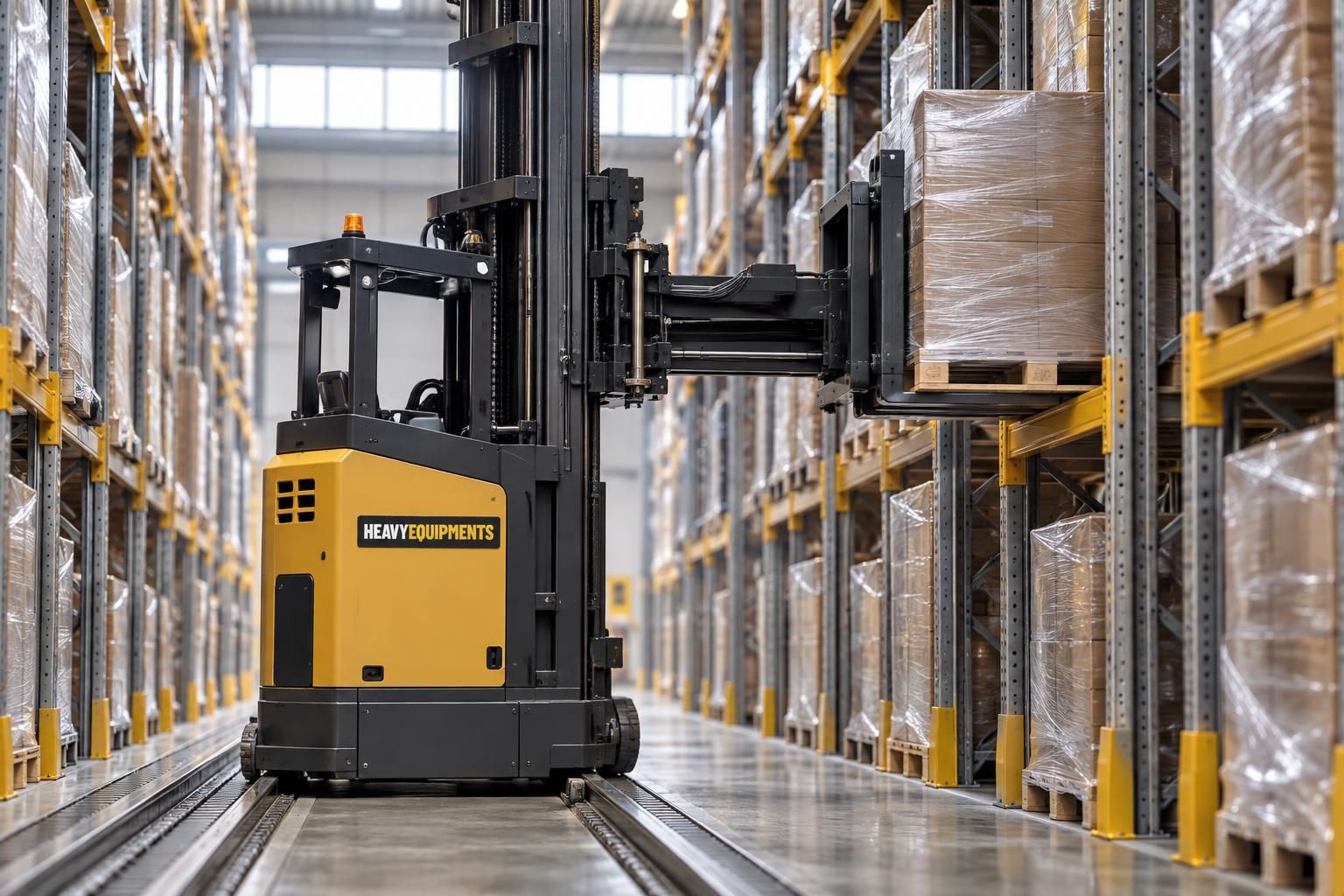
A turret forklift is a specialized VNA truck designed for tightly spaced aisles. Its defining feature is a fork turret that rotates to pick and place loads without turning the entire truck. Many turret trucks lift the operator along with the forks (man-up) for case and each picking, while others are man-down for pallet handling. They are typically electric and often use stand up forklift operator compartments. They also rely on in-aisle guidance so operators focus on picking rather than steering.
How it differs from other warehouse equipment
- Counterbalance warehouse forklift Versatile inside and outside work in wider aisles, turning to face loads. Great for docks and staging, not optimized for VNA density.
- Order picker forklift Man-up for case picking from racks. Strong at e-commerce and piece picking, but not intended to handle full pallets at high throughput in VNA like a turret.
- Reach truck Narrow aisle with deep-reach pallets, still turns in the aisle and lacks the turret’s rotate-and-store efficiency in very narrow aisles.
When VNA and turret forklifts make sense
Turret trucks shine when storage density and high SKU counts pressure your footprint. Consider VNA if you:
- Need to add aisles or vertical capacity inside your current building rather than expanding.
- Have high SKU variety with frequent case or each picks where man-up turret selection saves travel.
- Operate multi-shift with predictable inventory flow where higher storage density offsets added complexity.
- Can commit to a defined traffic plan with fixed inbound and outbound points and minimal cross-aisle mixing.
Think twice if you have frequent mixed traffic (pallet jacks, counterbalance forklifts, pedestrians) in the same aisles or if rack layouts change constantly. Rough or uneven floors also work against VNA. Turret forklifts reward consistency and precision.
Facility layout and infrastructure planning
Before buying or renting turret equipment, audit your building and layout. The essentials:
- Racks Ensure racking is rated and aligned for the loads you plan to store. Turret operations benefit from straight, plumb racks with consistent beam elevations and clear flue spaces.
- Floor VNA work assumes a flat, well-maintained floor to keep mast deflection and sway in check. Evaluate slab condition, joints, and transitions to docks or tunnels.
- Aisle ends Provide generous set-down and staging room outside aisles so turret trucks can transition off guidance safely and exchange pallets smoothly with other equipment.
- Power and charging Turret forklifts are typically electric. Plan battery rooms and charging zones, including fast-charge positions that do not conflict with aisle access.
- Visibility and lighting Good lighting and consistent rack labeling aid precise pallet engagement at height.
- IT systems If you pick from man-up turrets, ensure your WMS tasks, RF scanners, and slotting logic support vertical travel efficiency, grouping picks on a lift to minimize up and down cycles.
Guidance options wire and rail
Turret forklifts usually rely on in-aisle guidance to keep the truck centered while the operator focuses on the mast and forks. Two common approaches:
- Wire guidance An embedded wire in the floor creates a guidance signal. This keeps aisle edges clean with no physical obstructions for pallets. It does require floor cutting and careful installation, and later changes take more work.
- Rail guidance Low-profile rails anchored at aisle edges guide the truck. Rails are easier to relocate with racking and provide a clear physical reference. They reduce usable width at the base of racks and can complicate housekeeping if debris accumulates near rails.
Either method can work well. Select based on your building’s slab condition, need for future reconfiguration, housekeeping practices, and whether you share aisles with other equipment.
Cost and ROI for your business case
You will not see a true payback picture until you capture the whole system, not just the forklift. Line up these cost buckets and benefits:
Key cost buckets to plan
- Turret forklifts Truck acquisition or rentals, batteries, chargers, and any height-management or camera aids.
- Guidance Wire installation or rail purchase and anchoring, plus maintenance access at aisle ends.
- Racking and layout Adjusted beam elevations, added bays, end-of-aisle protection, labeling.
- Floor work Flatness remediation, joint repair, and any trenching for wire guidance.
- Training and procedures Operator certification for man-up work, rescue plans, and updated traffic rules.
- IT and process WMS slotting, task interleaving, and pick-path logic tailored to VNA.
Benefits to include in ROI
- Higher storage density More pallets or SKUs in the same building footprint.
- Reduced travel Rotate the forks to access both rack faces while staying centered in the aisle.
- Faster case and each picking (man-up) Less back-and-forth between aisles and levels when tasks are batched smartly.
- Dock and staging efficiency Dedicated VNA for storage and other trucks at docks, less congestion if roles are separated.
Build your model around throughput targets and shifts, plus inventory turns. If you can defer a building expansion by densifying, VNA can justify itself even with the added infrastructure.
How turret forklifts compare with common warehouse forklifts
Most facilities already rely on counterbalance or diesel forklifts for docks, yard moves, and general handling. Use the following verified specs as a baseline. Turret forklifts differ by working in much tighter aisles with a rotating turret head and in-aisle guidance; they are typically electric and focused on high-density storage and case picking.
| Model | Capacity | Load center | Standard lift height | Power | Mast type | Turning radius |
|---|---|---|---|---|---|---|
| Toyota 8FBMT30 | 3,000 kg (6,614 lb) | 500 mm (19.7 in) | 3,000 mm (118.1 in) | Electric (80 V) | Duplex / Triplex options | 2,200 mm (86.6 in) |
| Linde H25 | 2,500 kg (5,512 lb) | 500 mm (19.7 in) | 3,150 mm (124.0 in) | Diesel | Duplex / Triplex options | - |
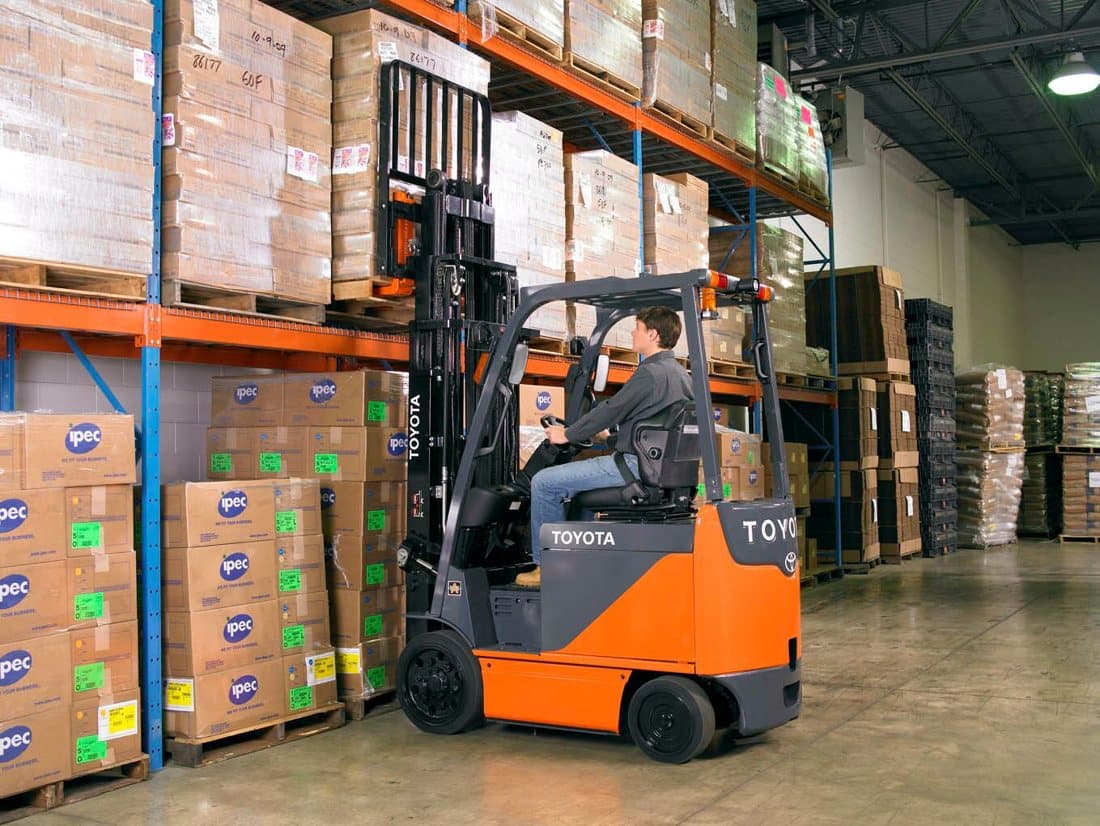
These specs illustrate a typical warehouse forklift baseline: counterbalance capability, conventional mast, and general-purpose lift heights. A turret forklift, by contrast, uses a rotating carriage to engage loads in the rack without the truck turning, and it depends on either wire or rail guidance. Many turret models are engineered for man-up order selection as well as pallet handling, whereas a standard electric forklift is usually optimized for dock-to-rack moves and staging. If your operation mostly handles full pallets at docks, trucks like the electric Toyota 8FBMT30 or a diesel unit like the Linde H25 remain efficient choices outside VNA aisles.
Operational tips to make VNA work
- Separate roles Keep turret forklifts dedicated to VNA storage and picks, and use counterbalance trucks for docks and replenishment outside the aisles.
- Slot for vertical work Group high-velocity items by level and aisle to minimize mast movement and long lifts.
- Standardize pallets Consistent pallet quality and dimensions reduce fork adjustments and retrieval errors at height.
- Plan charging cadence Align battery changes or charging windows with shift breaks to protect uptime for electric forklift fleets.
- Protect aisle entries End-of-aisle guardrails and clear signage reduce impacts to guidance rails or floor-embedded wires.
- Train for man-up procedures If you run man-up order picker forklift tasks on turret trucks, reinforce fall protection, platform operation, and rescue plans.
Next steps for VNA evaluation
- Map your loads and SKUs, plus pick types. If VNA fits, plan racks, guidance, and traffic flows as a package, not piecemeal.
- Use our spec database to benchmark forklifts you already run, then shortlist VNA-capable options.
- Drop candidate trucks into specs compare to evaluate capacity and lift requirements against your heaviest pallets and tallest bays.
- Check current for-sale listings and rentals for near-term capacity, and plan support via parts and attachments.
With the right layout, guidance, and operating discipline, a turret forklift can turn unused airspace into productive storage and speed up case picking (often the most constrained link in modern distribution).