Trencher Buying Guide, Chain Types, Boom Depth and Hydraulics
A practical guide to trencher chains and teeth, boom depth, and hydraulic requirements, with advice on walk behind, mini skid, and skid steer options.
Picking the right trencher comes down to the ground you are cutting and the trench you need, along with the carrier machine’s hydraulics. This guide explains chain and tooth styles, boom depth choices, how hydraulic flow and pressure affect performance, and when to use a walk‑behind, mini skid steer, or skid steer trencher. We also point to example machines so you can judge size and weight class for your jobs.
Trencher chain types and cutting teeth
Chains and teeth determine how fast you can cut and how clean your trench will be. The right setup saves teeth, reduces stalls, and keeps spoils moving away from the cut.
- Dirt or cup chains are best in soft to moderate soils. Cup-style teeth scoop material and clear it efficiently. They wear faster in rock or heavy gravel.
- Rock chains are built for fractured rock, cobble, or frozen ground. Teeth prioritize fracturing and chipping rather than scooping. Expect slower forward travel but fewer stalls.
- Combo chains mix cup and rock-style teeth to handle variable conditions on one pass. Useful when crossing mixed soils without swapping chains.
- Tooth materials Dirt teeth cut fast and are economical. Carbide-tipped or all‑carbide teeth hold up in abrasive soils and rock, reducing changeouts.
Tip: Match chain to the hardest material you expect to hit. Running a dirt chain into rock will bog the attachment and overheat hydraulics; a rock or combo chain in softer soil will still work, just at a slightly slower rate.
Boom depth, trench width, and spoils control
Booms set your max trench depth while chain selection and bar/chain setup set trench width. Choose only the depth and width you truly need, going bigger than necessary multiplies the power required, increases wear, and adds to cleanup.
- Depth For shallow utilities, irrigation, or lighting conduits, a shorter boom is faster and easier to control. Deeper utilities and mainlines call for longer booms and more carrier stability.
- Width Narrow cuts reduce power draw and backfill, but ensure the trench is wide enough for your product and bedding.
- Crumber and auger A crumber bar cleans the trench bottom; an auger conveys spoils out of the cut. In sticky soils, aggressive auger flighting and steady feed help prevent clogging.
Hydraulic flow pressure and why they matter
Hydraulics make or break trencher productivity. In simple terms, flow influences chain speed while pressure influences torque to keep the chain moving under load. If your carrier’s flow is low for the attachment, you will see slow chain speed, frequent stalls, and heat buildup. If system pressure is modest, you may struggle in dense soils even if flow is adequate.
Check your carrier’s auxiliary hydraulics spec sheet for:
- Available auxiliary flow (standard or optional). Trenchers sized for “higher‑demand” circuits will generally call for a higher‑flow package.
- System pressure and whether a case drain is required. Many heavy trenchers call for a case drain to protect motor seals.
- Return line configuration to ensure low backpressure and proper cooling.
On compact tractors, auxiliary flow is typically modest, which steers you toward light‑duty hydraulic trenchers or PTO‑driven units. For reference, the Kubota MX4700 lists a pump flow of 36.0 LPM (9.5 GPM), and the Kubota MX5100 lists 34.8 LPM (9.2 GPM). That level of flow can run smaller hydraulic trenchers; for heavier trenching, consider PTO‑powered attachments or a skid steer with a higher‑demand auxiliary circuit.
Walk behind mini skid and skid steer trenchers
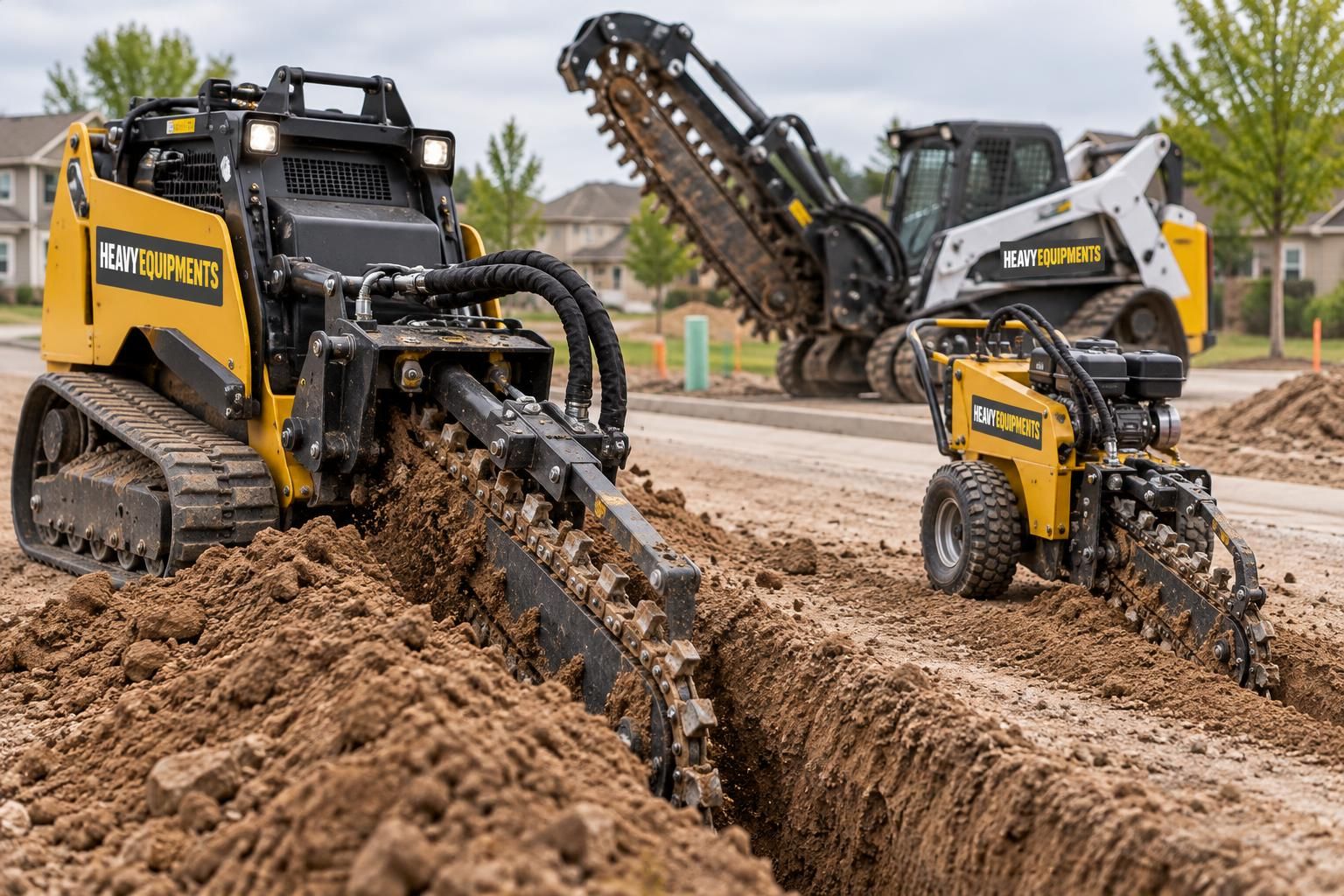
- Walk‑behind trenchers are best for short runs, tight access, and delicate turf where transport weight and ground pressure matter. They are simple to operate but slower and less comfortable over long distances.
- Mini skid steer trenchers add stand‑on mobility and quick repositioning with less turf disturbance than larger machines. Great for residential utilities, irrigation, and fencing, especially through gates and side yards.
- Skid steer trenchers deliver the highest production and versatility with the right hydraulic package. Heavier operating weights improve traction, helping the chain stay engaged without excessive hop. Ideal for long runs, deeper cuts, and tougher soils.
If you trench only occasionally or need a specialty setup for a single job, consider a trencher rental matched to your carrier’s hydraulics. Frequent trenching or mixed jobs may justify owning a dedicated attachment; browse attachments and used listings on for sale.
Skid steer and trencher size and weight examples
Use the examples below to think about machine classes often paired with trenchers. More operating weight helps traction and spoil management, and higher horsepower can support more demanding attachments when paired with the right auxiliary hydraulics. Always verify your specific machine’s hydraulic flow, pressure, and coupler/case‑drain requirements before you choose an attachment.
| Model | Lift Design | Horsepower | ROC @ 50% tipping | Tipping Load | Operating Weight |
|---|---|---|---|---|---|
| John Deere 240 | Vertical | 39.5 kW (53.0 HP) | 680.4 kg (1500 lbs) | 1542.2 kg (3400 lbs) | 2796.4 kg (6165 lbs) |
| Case Sr160 | Radial | 44.7 kW (60.0 HP) | 725.7 kg (1600 lbs) | 1451.5 kg (3200 lbs) | 2499.3 kg (5510 lbs) |
| Bobcat S595 | Vertical | 55.2 kW (74.0 HP) | 997.9 kg (2200 lbs) | 1995.8 kg (4400 lbs) | 3081.3 kg (6793 lbs) |
| Caterpillar 246d | Radial | 55.4 kW (74.3 HP) | 975.2 kg (2150 lbs) | 1950.4 kg (4300 lbs) | 3367.5 kg (7424 lbs) |
| Kubota Ssv75 | Vertical | 55.4 kW (74.3 HP) | 1220.2 kg (2690 lbs) | 2440.0 kg (5379 lbs) | 3819.8 kg (8421 lbs) |
| Takeuchi TS80V2 | Vertical | 55.2 kW (74.0 HP) | 1363 kg (3005 lbs) | 2726 kg (6010 lbs) | 4134 kg (9115 lbs) |
| Case 90XT | Radial | 63.4 kW (85.0 HP) | 1111.3 kg (2450 lbs) | 2222.2 kg (4900 lbs) | 4059.7 kg (8950 lbs) |
| John Deere 332G | Vertical | 74.6 kW (100.0 HP) | 1701 kg (3750 lbs) | 3269 kg (7200 lbs) | 4540 kg (10000 lbs) |
Here is how to read this table for trenchers. Smaller machines can run light‑duty trenchers in soft soils and shallower cuts. Mid‑frame models offer better traction and stability for moderate depths and mixed conditions, while the heaviest machines provide the traction and hydraulic headroom that demanding trenchers require. Vertical‑lift machines can help keep a trencher level as you raise to clear spoils or transport, while radial‑lift machines remain excellent trenching platforms thanks to their strong low‑to‑mid lift arc.
Set up your trencher for productivity and component life
- Right‑size the attachment Match chain width and boom depth to the requirement, oversizing robs hydraulic performance.
- Check hydraulics first Confirm auxiliary flow, pressure, and case‑drain needs against the trencher’s spec sheet before delivery day.
- Keep spoils moving Use steady ground speed to avoid plugging the auger. In sticky soils, shorten passes and let the attachment clear.
- Avoid dead stalls If the chain slows, ease off and let torque recover. Persistent stalls create heat and shorten motor and hose life.
- Teeth maintenance Rotate or replace worn teeth early, an uneven chain beats up bearings and sprockets.
When a trencher is not the right tool
Solid bedrock, very large diameter utilities, or trench depths beyond what your attachment can handle may call for an excavator and different tooling. A tracked excavator such as the Caterpillar 320D2 lists an operating weight of 21,900 kg, engine power of 108 kW, bucket capacity of 0.9 to 1.2 m³, a max digging depth of 6,720 mm, and a diesel powertrain on a tracked undercarriage, capabilities that enable deeper utility installation and trench shaping beyond what compact trenchers are built for.
Next steps to compare and shop
- Confirm your carrier’s hydraulic specs and coupler/case‑drain setup, then shortlist attachments sized to that capability.
- Use our database to research machines and attachments: browse specs or make head‑to‑head lists with Compare.
- Ready to acquire? Check current for sale listings, source parts, or line up a trencher rental.