Tractor Parts Guide to PTO, 3 Point, Hydraulics and Filters
A practical guide to PTO, 3 point hitches, hydraulics, and filters, plus a quick spec comparison to help you match implements and attachments.
Whether you run a compact around the acreage or manage a mixed fleet, understanding key tractor parts (PTO, 3‑point hitch, hydraulics, and the filtration system) leads to safer operation, better implement performance, and fewer breakdowns. This guide covers the essentials, then compares hydraulic flow and lift capacity across select models so you can match tractor attachments and tractor implements with fewer surprises.
PTO basics and reliable operation
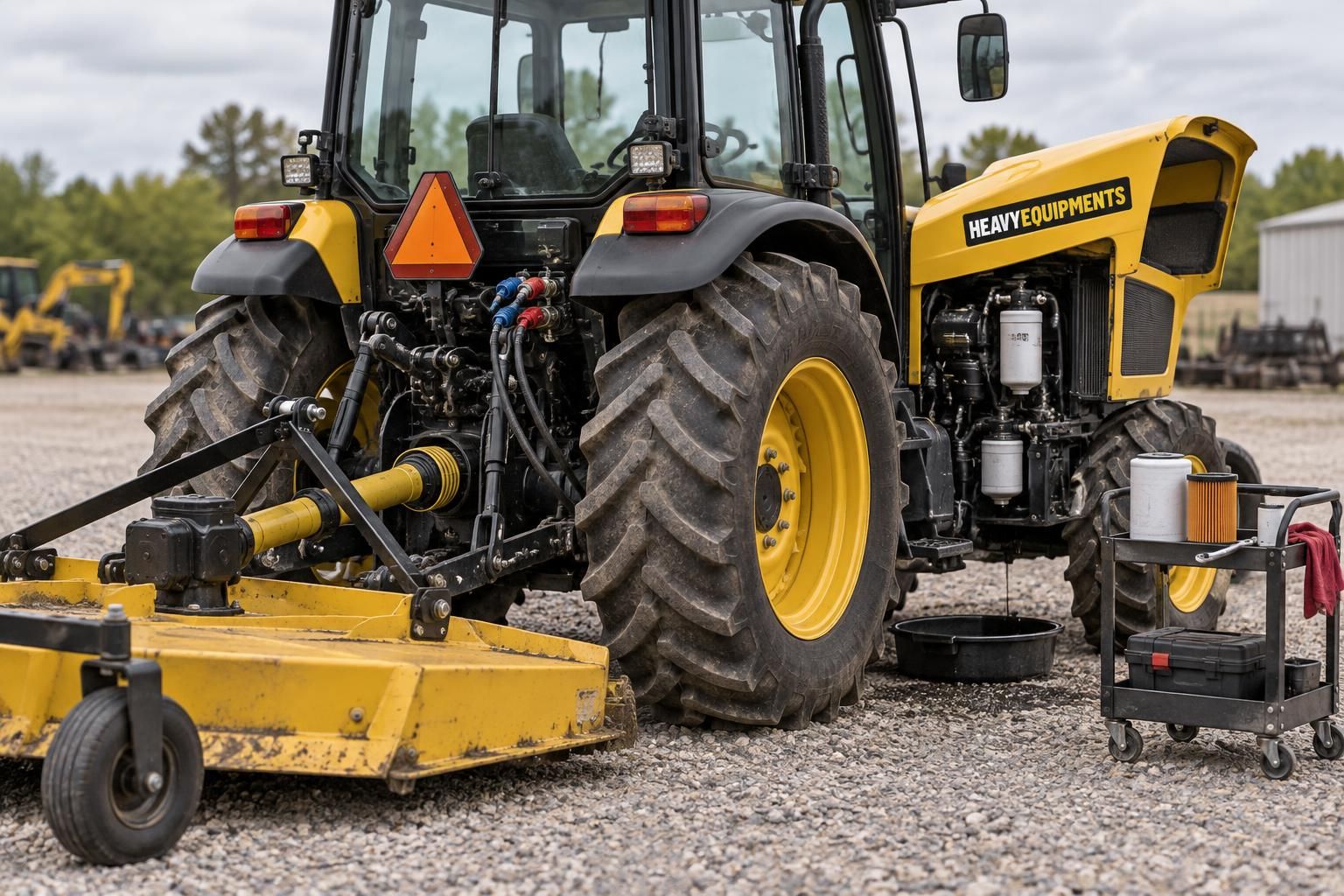
The power take‑off transfers engine power to driven implements such as rotary cutters, post hole diggers, and spreaders. While PTO details vary by model, your daily routine should focus on function and safety.
- Confirm engagement: Make sure the PTO engages cleanly and fully disengages. Hesitation or grinding suggests linkage, clutch, or transmission issues that need attention.
- Inspect the shaft and guard: Check the shield rotates freely and isn’t cracked. Look for spline wear on the stub shaft and implement yoke.
- Listen under load: Excess vibration or chatter with a PTO‑driven implement points to driveline wear, bent shafts, or a tired clutch.
- Match implements to the tractor: Smaller tractors like the Massey Ferguson 1010 won’t handle the same PTO load as heavier row‑crop or 4WD units.
Many tractors use dry disc clutches in the driveline (for example, the John Deere 1010 has a sliding gear transmission with a dry disc clutch). If engagement gets jerky or slips, stop. Continued use can glaze the disc and damage mating parts.
Three point hitch setup and capacity
The 3‑point hitch lifts, carries, and stabilizes mounted implements. Key parts include the lower draft arms, ball ends, sway/stabilizers, and the adjustable top link. A few practical checkpoints:
- Ball ends and pins: Replace egg‑shaped balls or bent pins to prevent hitch slop and implement sway.
- Stabilizers: Keep side‑to‑side movement in check to protect PTO joints and hydraulic couplers.
- Top link length: Adjust so the implement sits level at working height, not just when parked.
Lift capacity determines what you can safely pick up and carry. Capacities vary widely: compact and utility tractors like the Kubota MX4800, Kubota MX5200, and Kubota MX5800 list 1300.0 kg (2866.0 lbs), while a utility model such as the John Deere 6300 lists 2220.0 kg (4894.3 lbs). The New Holland T4.75 offers 2190.0 kg (4828.1 lbs). Larger row‑crop and 4WD models jump higher, New Holland 8970 at 6804.0 kg (15000.2 lbs), New Holland 9282 at 5895.0 kg (12996.2 lbs), and John Deere 9620 at 6550.0 kg (13867.1 lbs). Some high‑horsepower crawlers like the John Deere 9570RX list 9070.0 kg (19995.9 lbs).
Rule of thumb for setup: choose lift pins and hitch settings that keep the implement close to the rear axle, use stabilizers to minimize sway, and confirm transport height clears tires and drawbar.
Hydraulics basics flow lift and remotes
The hydraulic system powers your hitch, loaders, and selective control valves (SCVs/remotes). Two numbers matter daily: pump flow, which affects how quickly oil moves to cylinders and motors, and lift capacity at the hitch. Higher flow can bring snappier loader and remote response, while lift capacity determines how heavy an attachment you can raise and hold. Below, we compare representative models so you can see the range in real‑world numbers.
Hydraulic flow and lift capacity comparison
| Model | Tractor Type | Horsepower | Weight | Lift Capacity | Pump Flow | Transmission | Years Made |
|---|---|---|---|---|---|---|---|
| John Deere 1010 | Utility Tractor | 26.9 kW (36.1 HP) | 1780.0 kg (3924.2 lbs) | , | , | Sliding gear with dry disc clutch | 1960-1965 |
| Massey Ferguson 1010 | Compact Utility Tractor | 11.9 kW (16.0 HP) | , | 550.0 kg (1212.5 lbs) | 13.2 LPM (3.5 GPM) | Hydrostatic | 1982-1994 |
| John Deere 60 | Row-Crop Tractor | 34.3 kW (46.0 HP) | 2630.0 kg (5798.2 lbs) | , | 33.7 LPM (8.9 GPM) | Unsynchronized gear with dry disc clutch | 1952-1956 |
| John Deere 50 | Row-Crop Tractor | , | 2200.0 kg (4850.2 lbs) | , | 33.7 LPM (8.9 GPM) | Unsynchronized gear | 1952-1956 |
| John Deere 80 | Farm Tractor | 34.5 kW (46.3 HP) | 5210.0 kg (11486.1 lbs) | , | , | Unsynchronized gear with dry disc clutch | 1955-1956 |
| John Deere 6300 | Utility Tractor | 55.9 kW (75.0 HP) | , | 2220.0 kg (4894.3 lbs) | , | Partial power shift with triple wet disc PermaClutch clutch | 1992-1997 |
| Kubota MX4800 | Utility Tractor | 35.0 kW (Gear trans: 46.9 HP) | , | 1300.0 kg (2866.0 lbs) | 36.0 LPM (9.5 GPM) | Hydrostatic | 2014-Present |
| Kubota MX5200 | Utility Tractor | 38.9 kW (Gear trans: 52.2 HP) | , | 1300.0 kg (2866.0 lbs) | 36.0 LPM (9.5 GPM) | Hydrostatic | 2014-Present |
| Kubota MX5800 | Utility Tractor | 42.9 kW (57.5 HP) | 1694.0 kg (3734.6 lbs) | 1300.0 kg (2866.0 lbs) | 36.0 LPM (9.5 GPM) | Hydrostatic | 2015-Present |
| New Holland T4.75 | Utility Tractor | 55.2 kW (74.1 HP) | , | 2190.0 kg (4828.1 lbs) | 47.3 LPM (12.5 GPM) | Mechanical shuttle | 2012-2020 |
| New Holland 8970 | Row-Crop Tractor | 179.0 kW (240.1 HP) | , | 6804.0 kg (15000.2 lbs) | 90.8 LPM (24.0 GPM) | Full power shift | 1993-2000 |
| New Holland 9282 | Farm Tractor | 194.0 kW (260.1 HP) | 11250.0 kg (24802.0 lbs) | 5895.0 kg (12996.2 lbs) | 170.3 LPM (45.0 GPM) | Partially synchronized with hydraulic wet disc clutch | 1996-1999 |
| John Deere 9620 | Farm Tractor | 373.0 kW (500.2 HP) | 17735.0 kg (39098.9 lbs) | 6550.0 kg (13867.1 lbs) | 113.6 LPM (30.0 GPM) | Full power shift | 2004-2007 |
| John Deere 9570RX | Agricultural Crawler Tractor | 425.1 kW (570.1 HP) | 25175.0 kg (55501.3 lbs) | 9070.0 kg (19995.9 lbs) | 435.3 LPM (58.0 GPM (219.6 LPM) 115.0 GPM) | Full power shift | 2016- |
| Massey Ferguson 8680 | Row-Crop Tractor | 238.7 kW (320.1 HP) | 11000.0 kg (24250.8 lbs) | 5000.0 kg (11023.1 lbs) | 99.9 LPM (26.4 GPM) | Continuously variable transmission | 2009-2013 |
| Massey Ferguson 8660 | Row-Crop Tractor | 197.6 kW (265.0 HP) | 17640.0 kg (38889.5 lbs) | 5000.0 kg (11023.1 lbs) | 99.9 LPM (26.4 GPM) | Continuously variable transmission | 2009-2013 |
How to use the numbers above:
- Hydraulic flow: If you run a loader or hydraulic motor, compare your implement’s flow demand to the tractor’s LPM (GPM). Faster cycle times usually require higher flow.
- Lift capacity: Make sure the hitch rating exceeds your implement’s weight and center‑of‑gravity demands. For example, a 1300.0 kg (2866.0 lbs) rating on an MX‑series Kubota fits many medium blades and rotary cutters, while larger planters or rippers call for the lift of row‑crop or 4WD models.
Filter care engine fuel hydraulic air
Clean oil and fuel are cheap insurance. Follow your operator’s manual for exact intervals and fluid grades, and use quality replacement parts.
- Engine oil and filter: Change on schedule and after heavy PTO work or prolonged idling. Cut open old filters to spot metal or soot loading that signals deeper issues.
- Fuel filters: Drain water separators regularly and replace filters at the first hint of hesitation under load.
- Hydraulic and transmission filters: Replace on time, especially after high‑flow loader or remote work. Filters load faster on machines with smaller reservoirs or in dusty conditions.
- Air filters: Check the primary element more often during mowing and tillage. Avoid blowing dirt into the intake during cleaning.
Keep records. When a hitch lifts slowly or a loader gets spongy, notes on the last hydraulic filter and fluid change speed up troubleshooting.
Tractor battery and electrical checks
Your tractor battery is the heart of cold starts and reliable electronics. A few habits extend service life:
- Keep terminals clean and tight; repair frayed cables before they overheat.
- Secure the battery firmly to prevent vibration damage.
- Inspect the case for swelling or leaks and replace at the first signs of damage.
- If the machine sits, maintain a proper state of charge and protect from extreme temperatures.
Matching tractor attachments and implements
Before you buy or hook up:
- Confirm fit: Hitch category, pin size, and PTO interface should match your tractor.
- Check weight and balance: Compare implement weight to your hitch rating and plan ballast if needed.
- Hydraulic demand: Compare remote/motor flow needs to your pump flow (see table). High‑demand tools run better on tractors with higher LPM (GPM).
- Power demand: Make sure your tractor’s horsepower is appropriate for the implement’s workload.
Browse attachments and cross‑check your selections against model specs in our spec catalog.
Next steps for your tractor
- Compare models head‑to‑head with our specs compare tool.
- Find replacement filters, PTO drivelines, hydraulic hoses, and more in parts.
- Shop machines in for sale or short‑term options in rentals.
- Dig deeper into models featured above in the full specs library.
Get familiar with these tractor parts, verify your lift and hydraulic needs against the table, and you’ll be set up to run the right tractor attachments and tractor implements safely and productively.