Tractor Attachments That Fit Your 3 Point Hitch and PTO
A plain English guide to matching tractor attachments with your 3 point hitch category and PTO power, plus example specs across compact, utility, and high horsepower tractors.
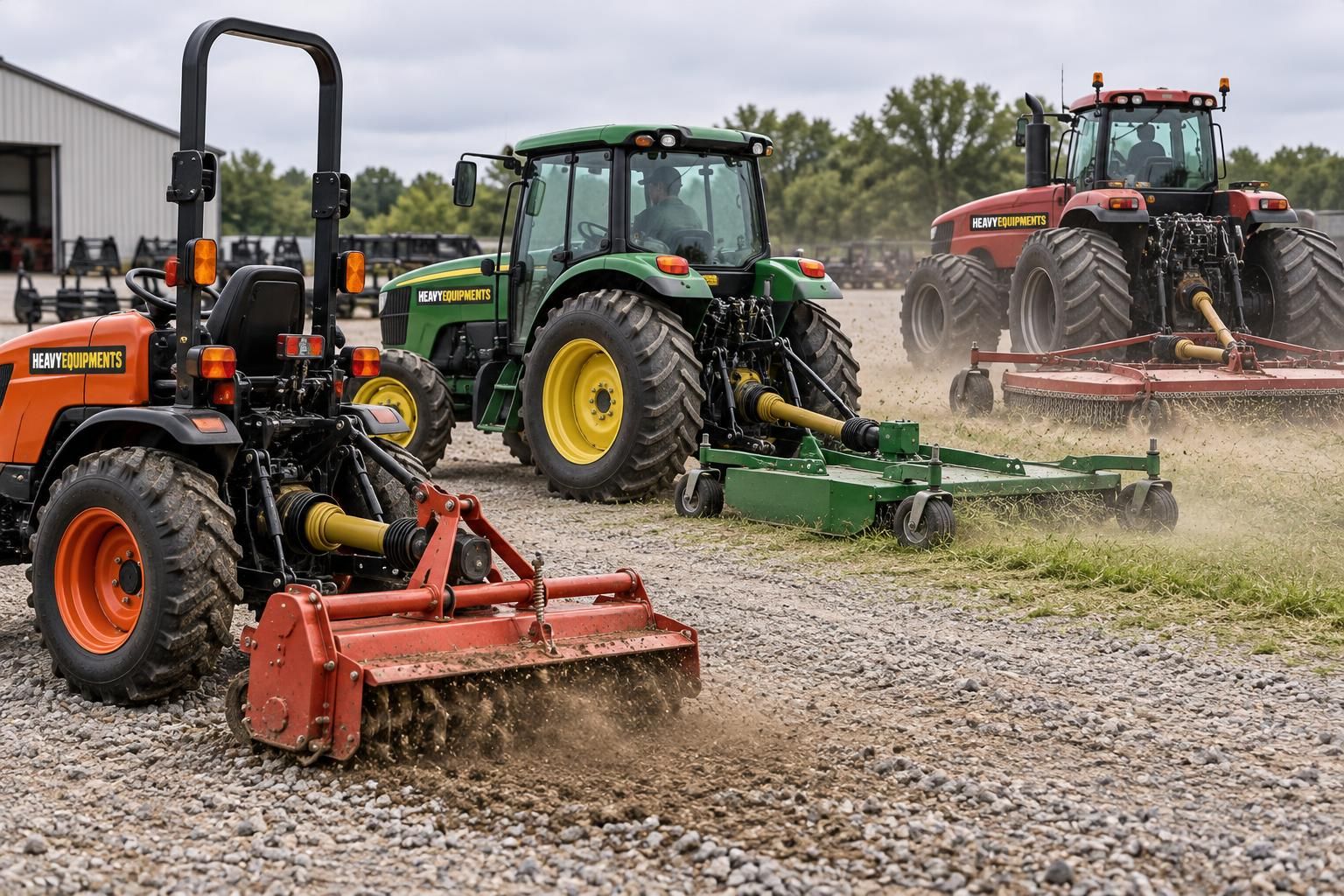
Getting the most from tractor attachments starts with two decisions: matching your three-point hitch category and making sure your tractor’s PTO can drive the implement. This guide explains both in plain English, then shows example tractors and specs so you can benchmark what’s realistic for compact tractors, utility machines, and high-horsepower row-crop or 4WD units.
What hitch category means and why it matters
Three-point hitch “categories” standardize the size of the hitch points and the spacing between lower arms. In practice, the category tells you which tractor implements will physically fit and latch correctly.
Big picture:
- Sub-compact and many compact tractor models typically use smaller hitch categories suited to lighter implements.
- Most utility tractors step up a category for wider cutters, heavier blades, and larger ground-engaging tools.
- Row-crop and high-horsepower tractors use larger categories to handle heavy, multi-row, or high-lift implements.
How to confirm your hitch category:
- Look for the category marking on your lift arms or in the tractor operator’s manual.
- Check the implement’s data plate or manual for its required category.
- If you’re unsure, measure your lift arm pin diameters and arm spacing and compare to the implement’s spec sheet before buying.
If the implement’s category doesn’t match your tractor’s, use approved conversion bushing kits only when the manufacturer permits it. Never force-fit pins. Mismatched parts can damage hitch components and create safety hazards.
PTO power and engine horsepower difference
Power Take-Off (PTO) rating matters because many attachments (mowers, post-hole diggers with hydraulic motors, generators, grain augers) depend on driven power. PTO horsepower is distinct from the engine’s gross horsepower; it’s the usable power at the PTO shaft after drivetrain losses. As a result, the PTO rating is typically lower than the engine number on the hood.
How to match an implement to your tractor’s PTO:
- Find your tractor’s PTO rating in the operator’s manual or spec label.
- Check the implement’s required PTO power on its tag/manual.
- Ensure the PTO speed and spline type match the implement.
- Leave margin so the tractor isn’t running at its limit in tough conditions (thick grass, hills, heavy soil).
Also consider your transmission when matching. Hydrostatic transmissions make it easy to keep PTO speed steady while creeping forward. Power shift and mechanical shuttles excel for draft work and consistent field speeds. Choose the setup that suits the attachment and task.
Lift capacity and hydraulics for attachments
Even if the hitch category and PTO line up, you still need enough rear lift capacity and hydraulic flow/pressure for the job. Heavy blades, ballast boxes, or tillers challenge the three-point; hydraulic motors and remotes demand adequate flow.
- Rear lift capacity (at the ball ends) indicates how much weight your three-point can raise and control.
- Hydraulic pump flow (LPM/GPM) influences how fast remotes and loaders cycle, and whether hydraulic-driven attachments operate as intended.
Below are example specs for tractors across sizes. Use these figures to benchmark where your tractor might land and what types of attachments are realistic.
Example tractor specs for attachment planning
| Model | Horsepower | 3-Point Lift Capacity | Hydraulic Pump Flow |
|---|---|---|---|
| Kubota MX4800 | 35.0 kW (46.9 HP) | 1300.0 kg (2866.0 lbs) | 36.0 LPM (9.5 GPM) |
| Kubota MX5200 | 38.9 kW (52.2 HP) | 1300.0 kg (2866.0 lbs) | 36.0 LPM (9.5 GPM) |
| Kubota MX5800 | 42.9 kW (57.5 HP) | 1300.0 kg (2866.0 lbs) | 36.0 LPM (9.5 GPM) |
| New Holland T4.75 | 55.2 kW (74.1 HP) | 2190.0 kg (4828.1 lbs) | 47.3 LPM (12.5 GPM) |
| John Deere 6300 | 55.9 kW (75.0 HP) | 2220.0 kg (4894.3 lbs) | |
| Massey Ferguson 8680 | 238.7 kW (320.1 HP) | 5000.0 kg (11023.1 lbs) | 99.9 LPM (26.4 GPM) |
| New Holland 9282 | 194.0 kW (260.1 HP) | 5895.0 kg (12996.2 lbs) | 170.3 LPM (45.0 GPM) |
| John Deere 9620 | 373.0 kW (500.2 HP) | 6550.0 kg (13867.1 lbs (6290.0 kg) Optional: 14440.3 lbs) | 113.6 LPM (30.0 GPM) |
| John Deere 9570RX | 425.1 kW (570.1 HP) | 9070.0 kg (15002.4 lbs (6805.0 kg) 19995.9 lbs) | 435.3 LPM (58.0 GPM (219.6 LPM) 115.0 GPM) |
| Massey Ferguson 8480 | 216.4 kW (290.2 HP) | 6530.0 kg (14396.2 lbs) |
How to read this: compact tractor and smaller utility models (e.g., MX series) combine modest lift capacity with modest hydraulic flow, great for lighter cutters, rear blades, small tillers, and seeders sized for compact acreage. Mid-utility models like the T4.75 and similarly powered tractors step up lift and flow for heavier-duty work. High-horsepower row-crop and articulated or crawler tractors bring major lift capacities and high flows for large planters, rippers, grain carts with hydraulic functions, and heavy 3-point toolbars, assuming your PTO and hitch setup match the implement’s requirements.
Step by step match tractor implements the right way
- Confirm hitch category on both tractor and implement. If they differ, use only approved adapters and bushings as specified by the manufacturer.
- Check PTO compatibility. Make sure PTO power, speed, and spline type match what the implement requires. Remember PTO horsepower will be lower than engine horsepower.
- Verify 3-point lift capacity. The implement’s operating weight, plus any material it carries, should be comfortably within your rated lift. Use the figures in the table above as context for what is typical across sizes.
- Confirm hydraulic needs. Compare the implement’s hydraulic flow and remote requirements to your tractor’s pump flow and available valves. For example, compact utility models around 36.0 LPM (9.5 GPM) will cycle more slowly than high HP machines with far higher flows.
- Mind tractor weight and wheelbase. Heavy ground-engaging tools demand traction and stability. Ballast as required, and follow the operator’s manual for front/rear weight distribution.
- Choose the right transmission for the job. Hydrostatic is user-friendly for loader work and mowing with frequent speed changes; power shift and mechanical shuttle excel with draft loads and steady field speeds.
- Do a quick safety check. Inspect hitch pins, lynch pins, top link, stabilizers, PTO guards, and hoses. Replace worn tractor parts before heading to the field.
Compact tractor focus practical pairings
A compact tractor is versatile when attachments are sized appropriately. For example, tractors in the power and capacity range of the Kubota MX series shown above combine around 1300.0 kg (2866.0 lbs) rear lift and roughly mid-30s LPM hydraulic flow, making them well-suited to many Category 1-compatible tasks like finish mowing, light grading, small aerators, spreaders, and seeders. Keep PTO-driven implements within your tractor’s PTO rating and maintain sharp blades and correct gear settings to avoid overloading.
Utility and high HP tractors step up responsibly
Utility models around 75 HP (see the New Holland T4.75 and John Deere 6300 in the table) often support heavier cutters, larger blades, and wider seeding tools. Verify the hitch category required by heavier-duty attachments, and confirm your PTO and hydraulic remotes meet any added demands like hydraulic-fold wings or down-pressure kits.
For large planters, big tillage tools, or heavy 3-point toolbars, high-horsepower tractors such as the Massey Ferguson 8680, New Holland 9282, John Deere 9620, and John Deere 9570RX bring substantial lift capacity and hydraulic flow options. Always confirm the implement’s hitch category and PTO requirements; large-frame machines may offer different PTO and hitch configurations depending on build.
Next steps for choosing attachments
- Look up full tractor specifications in our database: /specs/
- Put models side by side and compare horsepower, lift, and hydraulics: /specs/compare/
- Browse compatible tractor attachments by category: /attachments/
- See what’s available near you: /for-sale/ and /rentals/
- Keep your hitch and PTO in top condition with quality tractor parts: /parts/
Match the hitch category, confirm PTO and hydraulic needs, and use the example specs above to right-size your setup. Do that, and your tractor implements will work as intended, with fewer surprises and a safer, more productive day in the field.