Stand Up Forklifts, Aisle Widths, Capacities and Batteries
Plan aisle widths, read capacity and load center ratings, and choose a battery strategy that fits your shifts and space.
Choosing a stand-up forklift is mostly about fitting the truck to your building and your loads. Three decisions drive the spec, how narrow your aisles can be, how much weight you need to lift (and at what load center), and what battery and charging setup best fits your shifts. The sections that follow explain those choices in plain terms and include a quick comparison of two common warehouse forklift alternatives to help you benchmark aisle and capacity needs.
Where a stand up forklift excels
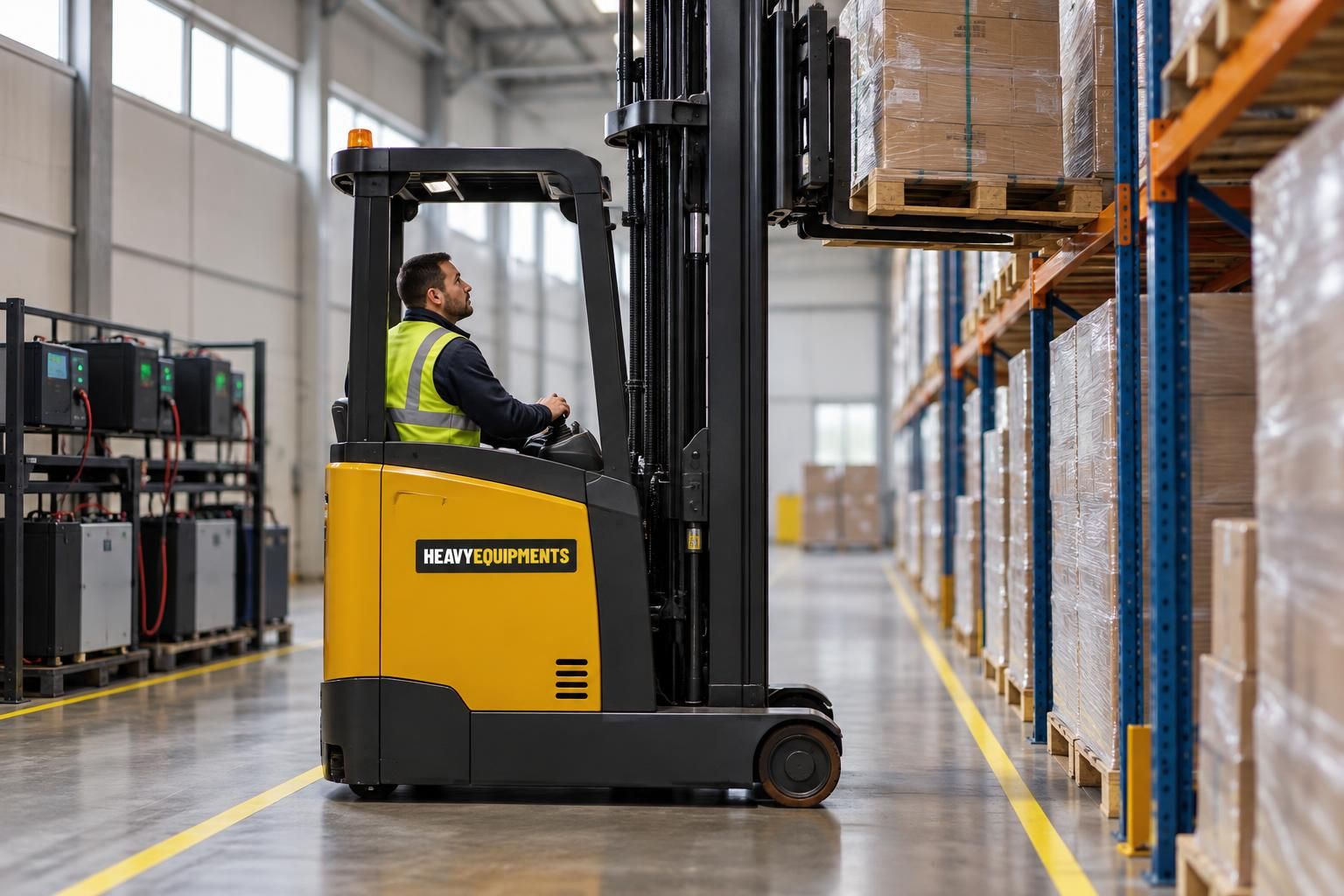
A stand-up forklift (often a reach forklift in racked warehouses) lets the operator step on and off frequently, work comfortably facing the load, and maneuver in tighter spaces compared with many sit-down counterbalance trucks. They shine on docks and staging lanes, plus tight aisles where visibility and quick entry or exit matter. If your operators shuttle short distances and handle mixed pallets around pedestrians, a stand-up design can reduce time lost mounting and dismounting and improve placement precision.
The right choice still depends on your environment. If you spend more time traveling longer distances with heavier loads, or you work outdoors, a sit-down counterbalance forklift may be the better fit. Use the aisle and capacity sections below to zero in on the right style.
Plan aisle width for tight turns
Aisle width is rarely a guess. It is a calculation based on your truck’s turning behavior plus your load length and the safety clearances your racking and local code require. Key inputs include:
- Turning characteristics of the truck (turning radius/right-angle stack)
- Load length and pallet overhang
- Rack beam and upright dimensions, flue space, and clearance targets
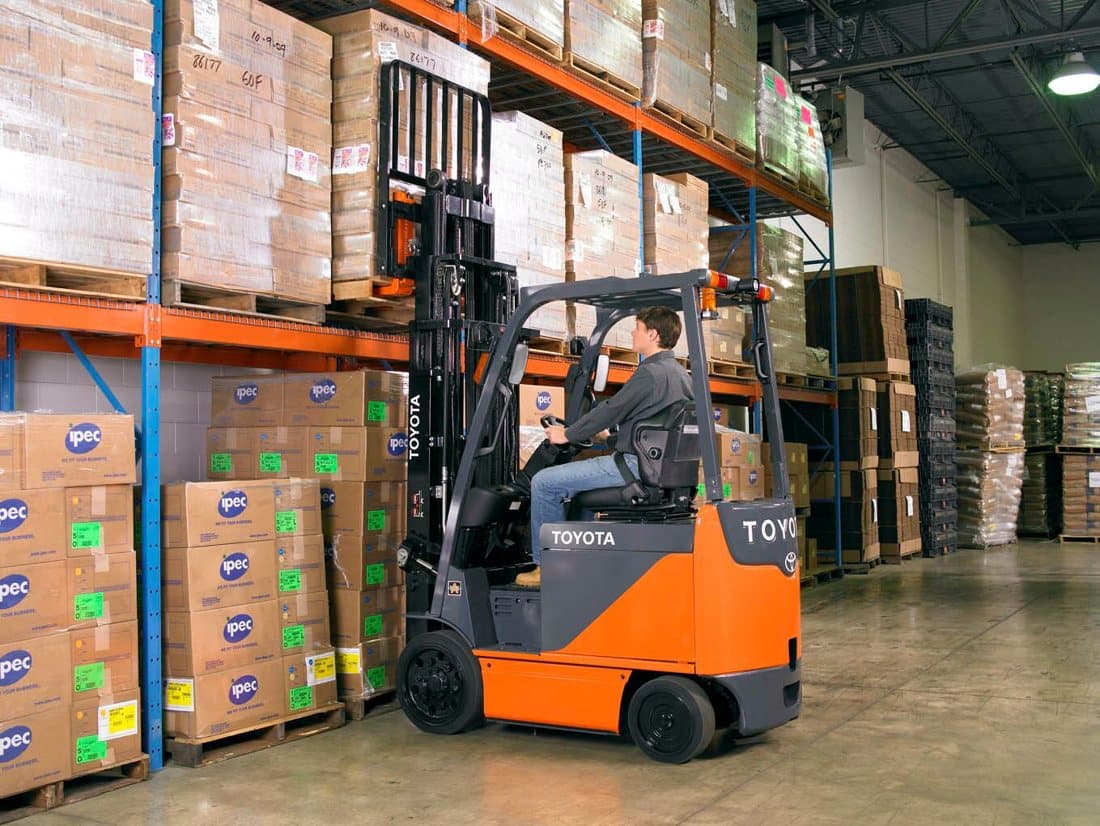
For context, an electric warehouse forklift such as the Toyota 8FBMT30 lists a turning radius of 2,200 mm (86.6 in). Your required aisle for a right-angle stack maneuver will be wider than the turning radius once you add load length and your chosen clearances. Stand-up reach forklifts typically work in tighter aisles than 4-wheel counterbalance trucks like this by allowing the chassis to stay straighter while the mast reaches into the rack, but the same planning principles apply.
Tips for designing aisles that work on day one:
- Start from the truck’s spec sheet turning behavior. If you don’t have a figure for the exact stand-up model you’re considering, use a counterbalance benchmark (like the Toyota above) to estimate conservatively, then validate with the actual reach truck data before you commit to rack spacing.
- Account for your longest real-world load, not an average pallet. Overhang and irregular packaging drive clearance needs.
- Model corners, intersections, and dock doors, not just straight aisles. The tightest spot sets your usable aisle width.
- Verify that charge bays, battery rooms, and staging areas leave enough room for turning and passing traffic.
Capacity and load center rating basics
Every forklift is rated at a specific capacity and load center. The rating holds as long as the load’s center of gravity matches the stated load center and the mast is within its rated operating range. Change either (longer loads, attachments, higher lifts), and the available capacity changes.
Two examples help frame this:
- The Toyota 8FBMT30 is rated for a capacity of 3,000 kg (6,614 lb) at a 500 mm (19.7 in) load center, with a standard lift height of 3,000 mm (118.1 in).
- The Linde H25 is rated for a capacity of 2,500 kg (5,512 lb) at a 500 mm (19.7 in) load center, with a standard lift height of 3,150 mm (124.0 in).
Both offer Duplex/Triplex mast options. On any forklift (stand-up reach, electric counterbalance, or diesel), remember:
- Attachments move the load center forward and reduce capacity.
- Lift height affects what you can safely place at upper levels; always consult the capacity plate and the load chart for your specific mast and carriage.
- Electric trucks often use the battery as part of the counterweight system; using the specified battery type and weight matters for stability.
For stand-up reach forklifts, expected capacity at height is often lower than the base rating due to the combination of reach mechanism and higher load centers on deep racking. Choose a rating that covers your heaviest and tallest regular task, not just your average pallet at ground level.
Battery choices and charging for electric forklifts
Most stand-up forklifts are electric. You’ll choose a voltage and battery format to match your duty cycle and facility. For example, the Toyota 8FBMT30 runs Electric (80 V). While battery chemistry and amp-hour specifics vary by model and option, the selection process comes down to:
- Shift pattern and downtime tolerance: Decide whether you’ll opportunity charge, fast charge, or swap batteries between shifts.
- Charging infrastructure: Ensure you have the electrical capacity and physical space for chargers, plus traffic flow that lets operators plug in without blocking aisles.
- Temperature and ventilation: Match battery type to your ambient conditions and follow manufacturer guidance on ventilation in charge areas.
- Maintenance approach: Some battery types and chargers reduce routine maintenance compared with others; factor tech skills and PM windows into your choice.
Plan battery rooms and charge bays with the same rigor as aisle design. Confirm reach access for service, clear signage, and floor markings to keep pedestrians out of high-traffic plug-in zones.
Counterbalance benchmarks for your stand up choice
While stand-up reach forklifts are purpose built for narrow aisles, it helps to compare them against common warehouse forklift alternatives. The table below lists two counterbalance examples (one electric and one diesel) so you can see how capacity, load center, lift height, and turning radius present on widely used trucks. Use these references when discussing rack spacing and load profiles with your team, then verify final aisle and capacity specs against the exact stand-up model you select.
| Model | Capacity kg (lb) | Load Center mm (in) | Standard Lift Height mm (in) | Power | Mast Type | Turning Radius mm (in) |
|---|---|---|---|---|---|---|
| Toyota 8FBMT30 | 3,000 (6,614) | 500 (19.7) | 3,000 (118.1) | Electric (80 V) | Duplex / Triplex options | 2,200 (86.6) |
| Linde H25 | 2,500 (5,512) | 500 (19.7) | 3,150 (124.0) | Diesel | Duplex / Triplex options | N/A |
How to use this table
- For aisle planning, if your benchmark 4-wheel electric shows a 2,200 mm (86.6 in) turning radius, expect a stand-up reach forklift to potentially work in a tighter aisle, but still add your load length and clearances when calculating final spacing.
- Capacity at a 500 mm (19.7 in) load center is the common warehouse reference point. If your loads are longer or you use attachments, select a higher base capacity or confirm a de-rated capacity that still covers your heaviest routine task.
- Mast choice matters. Duplex vs. Triplex affects lift height range and visibility; match to your top beam elevation and clearance needs. Confirm the specific mast chart for the stand-up model you shortlist.
Safety and ergonomics that drive productivity
Once aisle and capacity are in the right ballpark, focus on the operator experience, it drives real productivity:
- Stand-up designs cut steps for frequent on and off workflows such as case picking or dock work.
- Facing the load in a stand-up can help with precise pallet placement in narrow bays.
- Keep aisles clean and level, stand-up trucks and reach mechanisms perform best on smooth surfaces.
- Emphasize load center awareness and travel speed control in tight aisles. Train proper tilt and reach use.
Next steps to finalize your spec
1) Nail down your aisle targets and top beam elevations, then match them to spec sheets. Start in our specs database, and use Compare Specs to line up the stand-up models on your shortlist.
2) Verify capacity needs at your real load center and lift heights. Use the table above as a benchmark for common warehouse forklift ratings, and confirm final numbers on the exact stand-up reach or electric forklift you plan to buy or rent.
3) Plan your charging or fueling. For electric stand-up forklifts, map chargers, traffic flow, and shift timing before you place racks. If you need equipment now, browse for sale and rentals. If you’re keeping existing trucks running, see parts and attachments.
A stand-up forklift pays off when the building, battery plan, and load profile are aligned. Use the guidance above to get the fundamentals right, then finalize with detailed spec sheets and an in aisle demo before you buy.