Skid Steer Basics, How They Work, Sizes and Top Attachments
A plain English guide to what a skid steer is, how it works, sizes and capacities, and the attachments that move the most material. Includes a spec table of popular models.
If you have ever wondered what a skid steer is, it is a compact wheeled loader that turns by skidding its tires and powers dozens of attachments. Contractors lean on skid steer loaders for fast cycles in tight spaces, from grading and loading to sweeping, digging, snow, and more, because they are easy to trailer and maneuver, and they switch tools quickly.
Skid steer basics and how they work
A skid steer is a rigid-frame, wheeled loader with lift arms that accept a universal quick coupler. It steers by driving the wheels on each side at different speeds (or in opposite directions), causing the machine to skid and pivot within its own footprint. That gives tight turning and fast repositioning around stockpiles, trucks, and structures. Most models are available with enclosed cabs or open ROPS, and they are commonly spec’d with auxiliary hydraulics to run powered attachments.
Radial and vertical lift paths
Skid steers use two lift arm designs.
- Radial lift arcs forward as it raises. It is a solid choice for digging and grading, and for work that favors strong breakout at mid heights. Examples include the Caterpillar 246d and Case Sr160.
- Vertical lift keeps the load closer to the machine, with better reach at full height, handy for loading trucks and hoppers. Examples include the Bobcat S595, Bobcat S650, Bobcat S770, Caterpillar 262B, Caterpillar 272d, John Deere 240, John Deere 332G, and Kubota Ssv75.
Both lift paths handle buckets and forks well. Go vertical for frequent truck loading, and pick radial if ground engagement and mid lift work are the priority.
Understanding size and capacity
Two specs tell you how much a skid steer can carry:
- Tipping load is the weight that would cause the machine to tip forward.
- Rated Operating Capacity (ROC) is the allowable payload, expressed as a percentage of tipping load. Manufacturers may list ROC at 35% or 50% of tipping load; our table shows the 50% ROC where provided.
Smaller machines emphasize low ground disturbance and access; larger units bring higher horsepower, ROC, and stability for heavier attachments and faster truck loading. In the table below, models like the John Deere 240 and Case Sr160 represent lighter-duty sizes, while machines like the Bobcat S770, Caterpillar 272d, and John Deere 332G anchor the high-capacity end.
Skid steer spec snapshot
Use this table to benchmark horsepower and rated capacity, plus operating weight across popular models. All figures are manufacturer-provided. For side-by-side comparisons of additional models, try our spec compare tool.
| Model | Lift design | Horsepower | ROC (50% tipping) | Operating weight | Tipping load | Tilt breakout force |
|---|---|---|---|---|---|---|
| Bobcat S595 | Vertical | 55.2 kW (74.0 HP) | 997.9 kg (2200 lbs) | 3081.3 kg (6793 lbs) | 1995.8 kg (4400 lbs) | 2077.5 kg (4580 lbs) |
| Bobcat S650 | Vertical | 55.4 kW (74.3 HP) | 1220.2 kg (2690 lbs) | 3777.1 kg (8327 lbs) | 2440.3 kg (5380 lbs) | 2313.3 kg (5100 lbs) |
| Bobcat S770 | Vertical | 68.6 kW (92.0 HP) | 1519.5 kg (3350 lbs) | 4161.7 kg (9175 lbs) | 3039.1 kg (6700 lbs) | 2490.2 kg (5490 lbs) |
| Caterpillar 246d | Radial | 55.4 kW (74.3 HP) | 975.2 kg (2150 lbs) | 3367.5 kg (7424 lbs) | 1950.4 kg (4300 lbs) | 3366.2 kg (7355 lbs) |
| Caterpillar 262B | Vertical | 61.1 kW (82.0 HP) | 1224.7 kg (2700 lbs) | 3565.0 kg (7859 lbs) | 2449.4 kg (5400 lbs) | 2498.0 kg (5507 lbs) |
| Caterpillar 272d | Vertical | 73.1 kW (98.0 HP) | 1451.5 kg (3200 lbs) | 3742.1 kg (8250 lbs) | 2903.0 kg (6400 lbs) | 3379.3 kg (7450 lbs) |
| John Deere 240 | Vertical | 39.5 kW (53.0 HP) | 680.4 kg (1500 lbs) | 2796.4 kg (6165 lbs) | 1542.2 kg (3400 lbs) | 1406.1 kg (3100 lbs) |
| John Deere 332G | Vertical | 74.6 kW (100.0 HP) | 1701 kg (3750 lbs) | 4540 kg (10000 lbs) | 3269 kg (7200 lbs) | 3519 kg (7750 lbs) |
| Case Sr160 | Radial | 44.7 kW (60.0 HP) | 725.7 kg (1600 lbs) | 2499.3 kg (5510 lbs) | 1451.5 kg (3200 lbs) | 2390.4 kg (5270 lbs) |
| Kubota Ssv75 | Vertical | 55.4 kW (74.3 HP) | 1220.2 kg (2690 lbs) | 3819.8 kg (8421 lbs) | 2440.0 kg (5379 lbs) | 2667.1 kg (5880 lbs) |
About mini skid steers
People often use mini skid steer to describe very small, compact loaders (often stand-on machines) built for tight access, landscaping, and light material handling. They trade outright lift capacity for low weight and small footprints. If your work is primarily backyard or interior demo with narrow gates and walkways, a mini skid steer can be the right tool; if you need higher ROC, cab comfort, and frequent truck loading, look to the skid steer loaders in the table above.
The most productive skid steer attachments
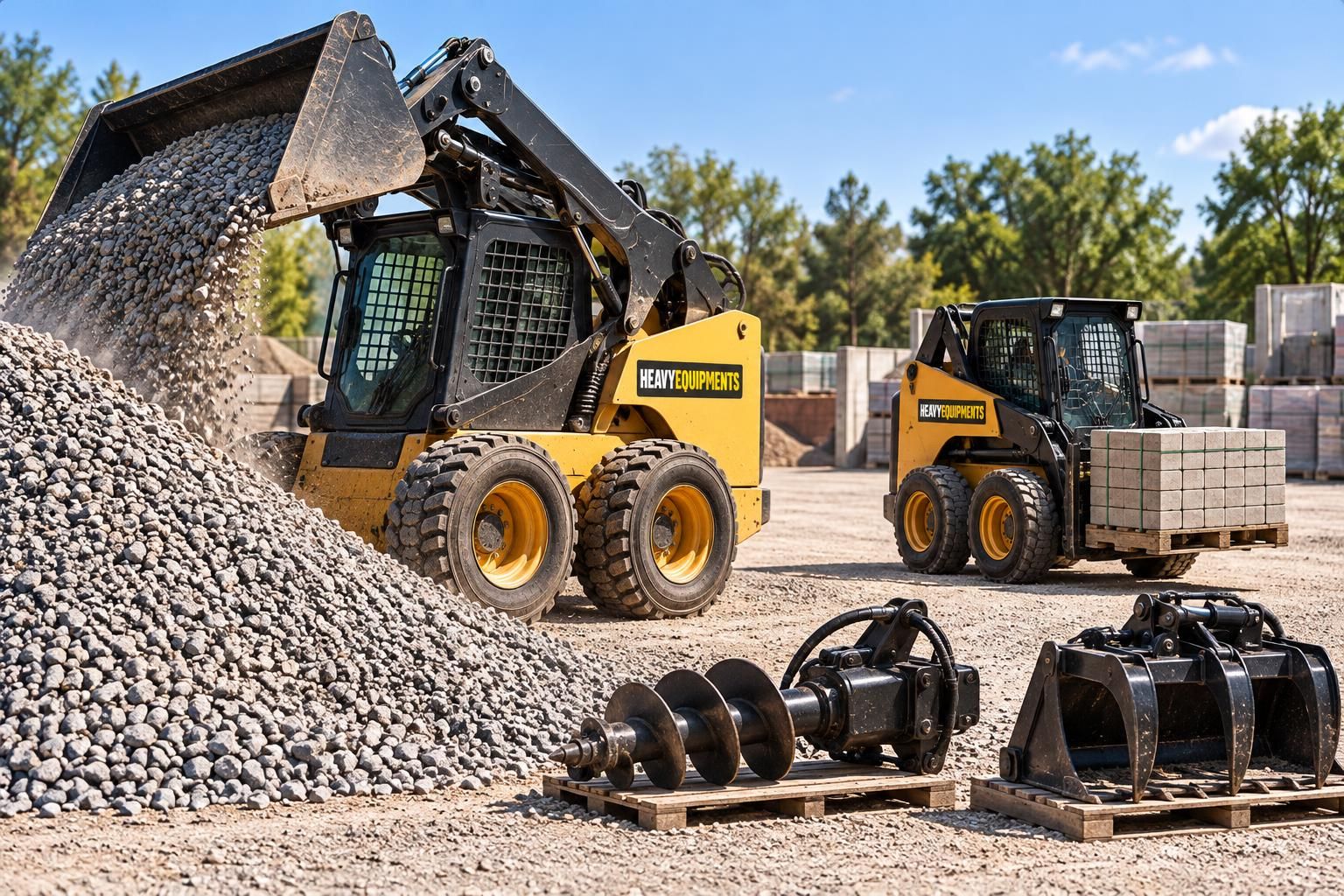
Attachments turn a skid steer into a fleet on wheels. Productivity comes from matching the tool to the job and to the machine’s capacity. Consider:
- General dirt work. Smooth and tooth buckets for digging and backfilling, plus 4-in-1 buckets for dozing and grabbing, with grading capability.
- Loading and yard work. Pallet forks for materials, and high capacity buckets for mulch, snow, or light aggregates.
- Ground engagement. Augers for posts, trenchers for utilities, plus rakes or landscape power rakes for finish grades.
- Brush, demo, recycling. Grapples for debris, brush cutters for vegetation, breakers for concrete and rock, and scrap or skeleton buckets for separation.
- Paving and maintenance. Cold planers for patches, brooms and sweepers for cleanup, and snow blowers or blades and pushers for winter work.
To keep cycle times high and downtime low:
- Right size the attachment to your machine’s ROC and operating weight to avoid overloads or stability issues.
- Check the machine’s hydraulic setup against the attachment’s needs, including flow and pressure, plus any case drain requirements.
- Mind visibility and lift path for loading tools; vertical lift can help when you are reaching over high sided trucks or bins.
Browse and price options on our attachments page, and cross‑check fitment with the models on our specs pages.
How to choose the right skid steer
Start with the work, then pick the machine:
- Size the machine using ROC (50%) and tipping load for your heaviest routine payloads with a suitable safety margin.
- Select a lift path that fits the work. Go vertical for frequent loading at full height, and choose radial for digging and mid lift work.
- If you are prying or ripping in dense material, higher tilt breakout forces (like those on the Caterpillar 272d or John Deere 332G) help keep the bucket moving.
- Match operating weight and overall size to your trailer capacity and site constraints.
- Confirm that the machine’s hydraulic capabilities align with your most demanding tool.
Next steps for buyers
- Dig deeper on models and build shortlists with our equipment specs and compare tools.
- Ready to buy? See what’s available near you on skid steers for sale, or line up a rental for upcoming work.
- Outfit your machine with job-matched attachments and keep it running with parts.