Guide to Order Picker Forklifts for Narrow Aisles
Key points on order picker forklifts for narrow aisles, from mast and lift height choices to electric battery planning and OSHA aligned safety, plus a quick spec look at two common models.
Picking cases or eaches in tight aisles is where an order picker forklift shines. If you are sorting out lift heights, batteries, and safety practices for a narrow-aisle operation, use this guide as a practical checklist. This guide clarifies the differences between an order picker (often called a cherry picker forklift) and other warehouse forklifts, how to think about mast and lift height choices, what to plan for with batteries on an electric forklift, and where OSHA aligned practices matter most. A small spec table for two common warehouse forklifts helps benchmark aisle and lift basics.
Order pickers and other warehouse forklifts
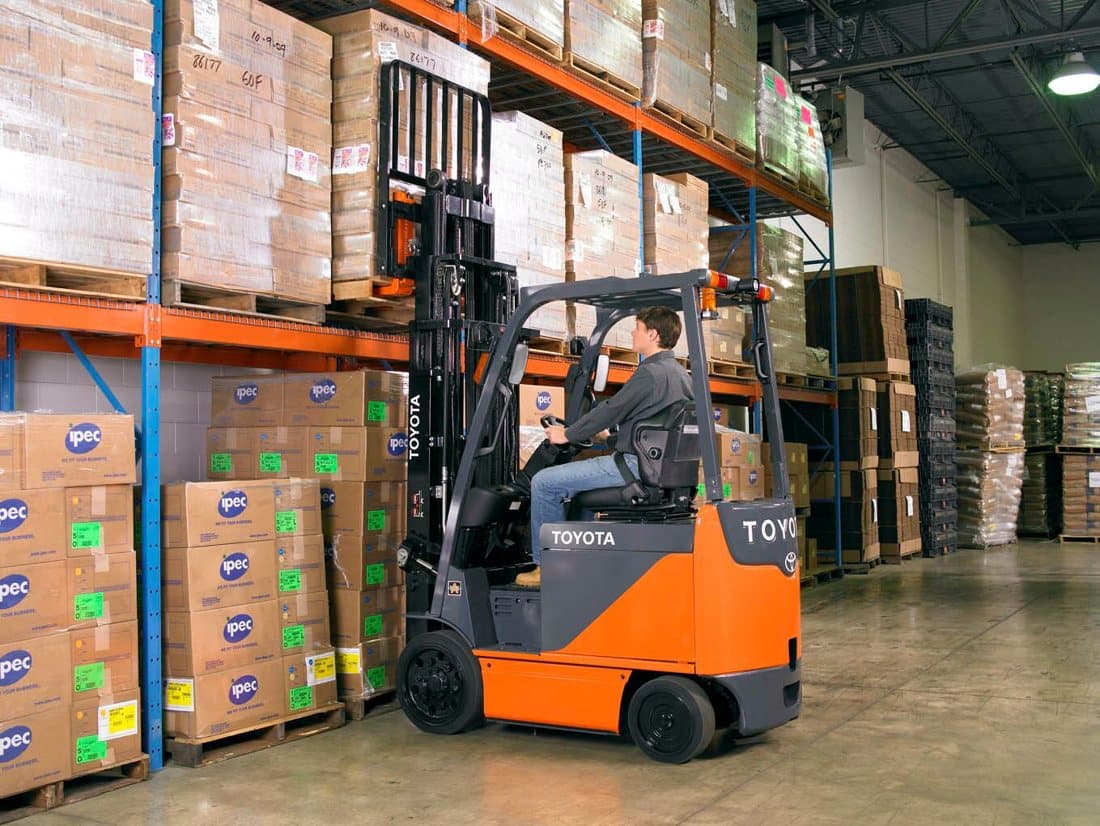
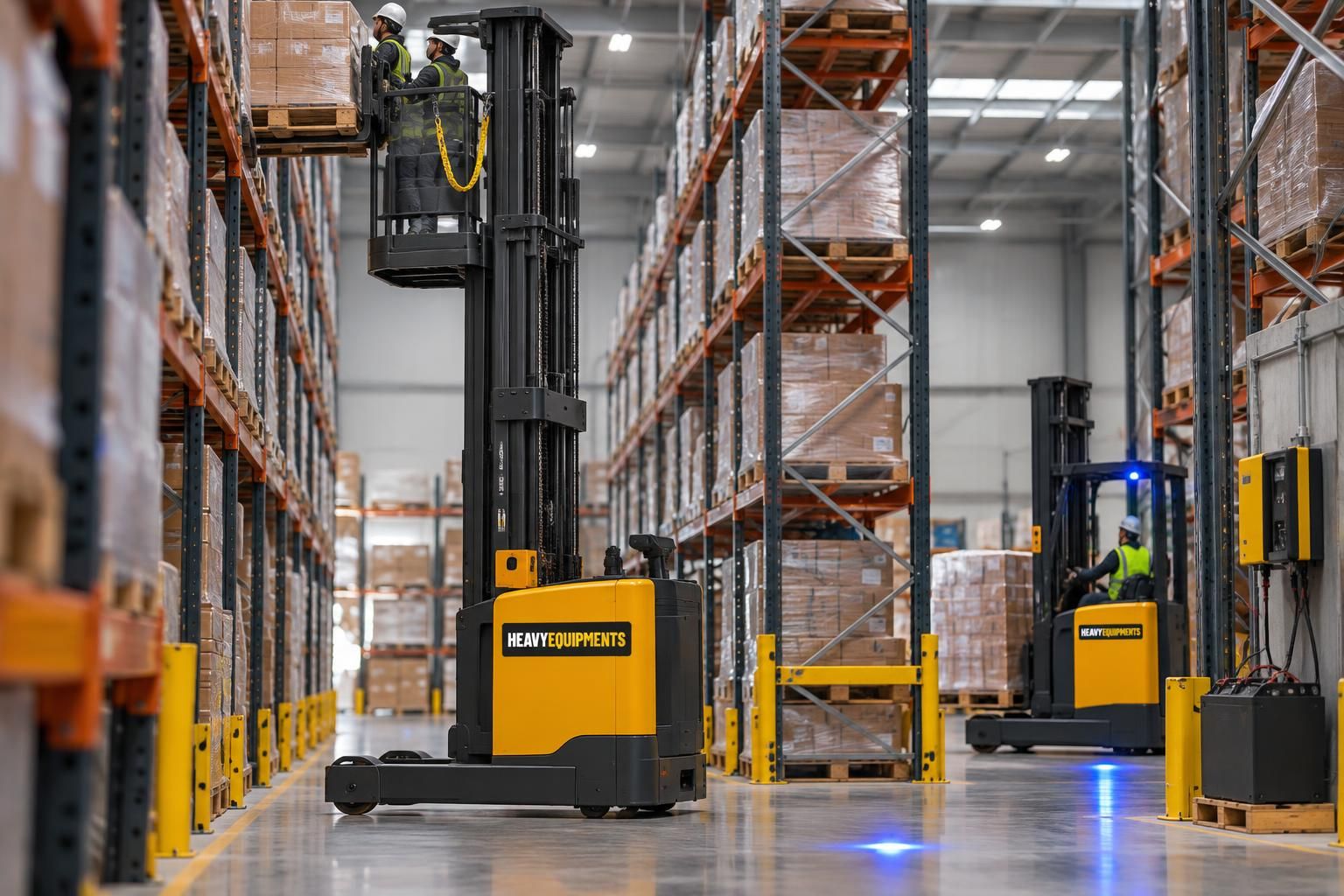
Order picker forklifts raise the operator platform to the pick location so one person can pull individual items directly from racking. By contrast, a counterbalance warehouse forklift moves full pallets from floor or rack to dock but keeps the operator at ground level. A stand up forklift can be more nimble in short aisle runs, but it still stays on the floor. In everyday conversation, people often say cherry picker forklift when they mean an order picker, both refer to machines that lift an operator to the work area inside the aisle.
Why this matters: if your team is picking individual cases at height, an order picker is usually the right tool. If you are mostly handling full pallets at or near floor level, a conventional counterbalance electric forklift (or a small diesel unit if ventilation allows) may be sufficient and simpler to deploy.
Lift heights and mast choices in narrow aisles
Choosing an order picker forklift starts with your top pick level plus a safety margin. You will specify a mast and platform that can reach the highest SKU location while maintaining stability and visibility. Duplex masts trade height for better visibility and rigidity; triplex masts fit higher lift in a lower collapsed height (helpful at dock doors and under low clearances). That trade-off applies to counterbalance forklifts too.
For reference, here are two warehouse forklifts with standard lift heights that are useful baselines when planning lower-level pallet moves versus elevated order picking:
| Model | Power | Capacity | Load center | Standard lift height | Mast type | Turning radius |
|---|---|---|---|---|---|---|
| Toyota 8FBMT30 | Electric (80 V) | 3,000 kg (6,614 lb) | 500 mm (19.7 in) | 3,000 mm (118.1 in) | Duplex / Triplex options | 2,200 mm (86.6 in) |
| Linde H25 | Diesel | 2,500 kg (5,512 lb) | 500 mm (19.7 in) | 3,150 mm (124.0 in) | Duplex / Triplex options | , |
How to use this table: these are counterbalance machines commonly seen in warehouses. Their standard lift heights are suitable for many ground-level pallet moves. Order picker forklifts typically reach higher within racking to position the operator at the pick face, so you will select a mast height that exceeds your highest pick level. If you have low door headers or mezzanines, prioritize a triplex mast to keep collapsed height down while still meeting your top pick requirement. When in doubt, capture exact rack elevations and obstructions, then compare detailed mast charts side by side on /specs/compare/.
Batteries and charging for electric forklifts
Most order pickers are electric for clean indoor operation and refined control. Planning the battery system is as important as picking the truck. Consider:
- Voltage and compatibility: for example, the Toyota 8FBMT30 runs Electric (80 V). Match your charger infrastructure and spare battery inventory to your truck voltage.
- Charging windows: decide whether you will opportunity charge during breaks or swap batteries between shifts. Keep charger locations clear of traffic and near ventilation suitable for your specific battery type.
- Battery care: follow manufacturer guidance for watering (if applicable), maintaining connections, and keeping battery tops clean and dry. Assign responsibility for daily checks as part of pre-shift inspections.
- Thermal and seasonal impacts: cold ambient temperatures reduce available power, plan rotations and charging access accordingly.
If your application involves occasional outdoor runs or poor ventilation control, note that diesel units like the Linde H25 are not suited to enclosed warehouse picking. In-aisle order picking is typically an electric forklift job due to emissions and precision control.
Aisle width, turning, and fleet mix
Narrow aisles demand the right combination of chassis size, mast, and operator platform. For counterbalance trucks, turning radius is a quick shorthand for maneuverability. The Toyota 8FBMT30 lists a turning radius of 2,200 mm (86.6 in), which helps in tighter cross-aisle moves and dock work. Order pickers move differently: the platform and load stay aligned in the aisle, so your limiting factor is usually aisle width, guide rails (if used), and any rack overhang, rather than a turning circle.
Many operations combine an order picker forklift for each-pick aisles with a small electric warehouse forklift for staging, replenishment, and dock work. That division keeps the picker focused on vertical travel and item access while the counterbalance handles pallet moves to and from reserve storage.
Safety and OSHA aligned practices for order picking
Order picking brings the operator up into the rack zone, so risk control centers on fall protection, stability, and visibility. Build your plan around these points:
- Operator training and evaluation: ensure operators are trained and evaluated on the specific truck type and attachments they will use. Retrain when conditions, equipment, or layouts change.
- Pre-shift inspections: check forks, mast chains, platform gates, controls, horn, brakes, tires, and for electric units, battery cables and connectors. Remove any truck from service that does not pass.
- Fall protection and guarding: keep platform gates closed and use the manufacturer-approved anchorage and PPE where required by your policy and applicable regulations.
- Load handling and capacity plates: respect the capacity at the stated load center. Both forklifts in the table specify a 500 mm (19.7 in) load center. Remember that raising the load center or adding attachments reduces capacity. Order pickers are no different, keep the load close and centered.
- Aisle traffic control: post one-way rules if needed, set end-of-aisle stop points, and maintain clear sightlines. Use spotters only when necessary and trained.
- Housekeeping: maintain flat, debris-free aisles; repair pallet damage promptly; remove protruding nails and wrap.
- Speed management: set conservative travel speeds for elevated work and enforce them with access controls where available.
Document your procedures, train for your site’s specific rack elevations and hazards, and follow the truck manufacturer’s guidance. When equipment changes (such as switching mast types or adding attachments), update training and capacity signage before returning the unit to service.
Spec tips when choosing an order picker forklift
- Map your highest pick and lowest clearance. Choose a mast that clears the tallest SKU location with margin while fitting under doors and sprinklers in the collapsed position.
- Confirm payload at your typical load center. If you handle long or awkward cartons, your effective load center may be higher, reducing capacity.
- Plan your charging and battery handling area. If you run electric forklifts across multiple shifts, decide between battery swapping and opportunity charging before you buy.
- Audit aisle widths. Account for rack upright deflection, pallet overhang, and any guidance systems. Order pickers typically do not turn in the aisle; they align and travel lengthwise, so the aisle needs to match the truck’s guidance and platform geometry.
- Consider a complementary fleet. Pair a dedicated order picker with a nimble warehouse forklift for dock and replenishment tasks to keep each machine in its sweet spot.
Where the example forklifts fit
Use the table above to benchmark lower-lift pallet work. The Toyota 8FBMT30 brings electric (80 V) power, a 3,000 kg (6,614 lb) capacity at a 500 mm (19.7 in) load center, and a 3,000 mm (118.1 in) standard lift height, solid for dock and staging inside clean warehouses. The Linde H25 is a diesel option with a 2,500 kg (5,512 lb) capacity and 3,150 mm (124.0 in) standard lift height; it is better suited to ventilated areas and outdoor support work rather than in-aisle order picking.
Next steps for your fleet
Dial in a truck for your aisles. Browse forklift specifications on /specs/, line up models side by side on /specs/compare/, and check current inventory on /for-sale/ and /rentals/. If you are maintaining a fleet, keep it moving with /parts/ and job-matched /attachments/. Define your top pick height, aisle constraints, and charging plan first. Then shortlist order picker forklifts that meet those constraints, and validate the details against the manufacturer’s data before you buy.