Mini Excavator Attachment Sizing for Thumbs, Augers and Breakers
Match hydraulic thumbs, augers, and breakers to your mini excavator by verifying pin groups, couplers, and auxiliary flow. A spec snapshot of popular minis helps right size your setup.
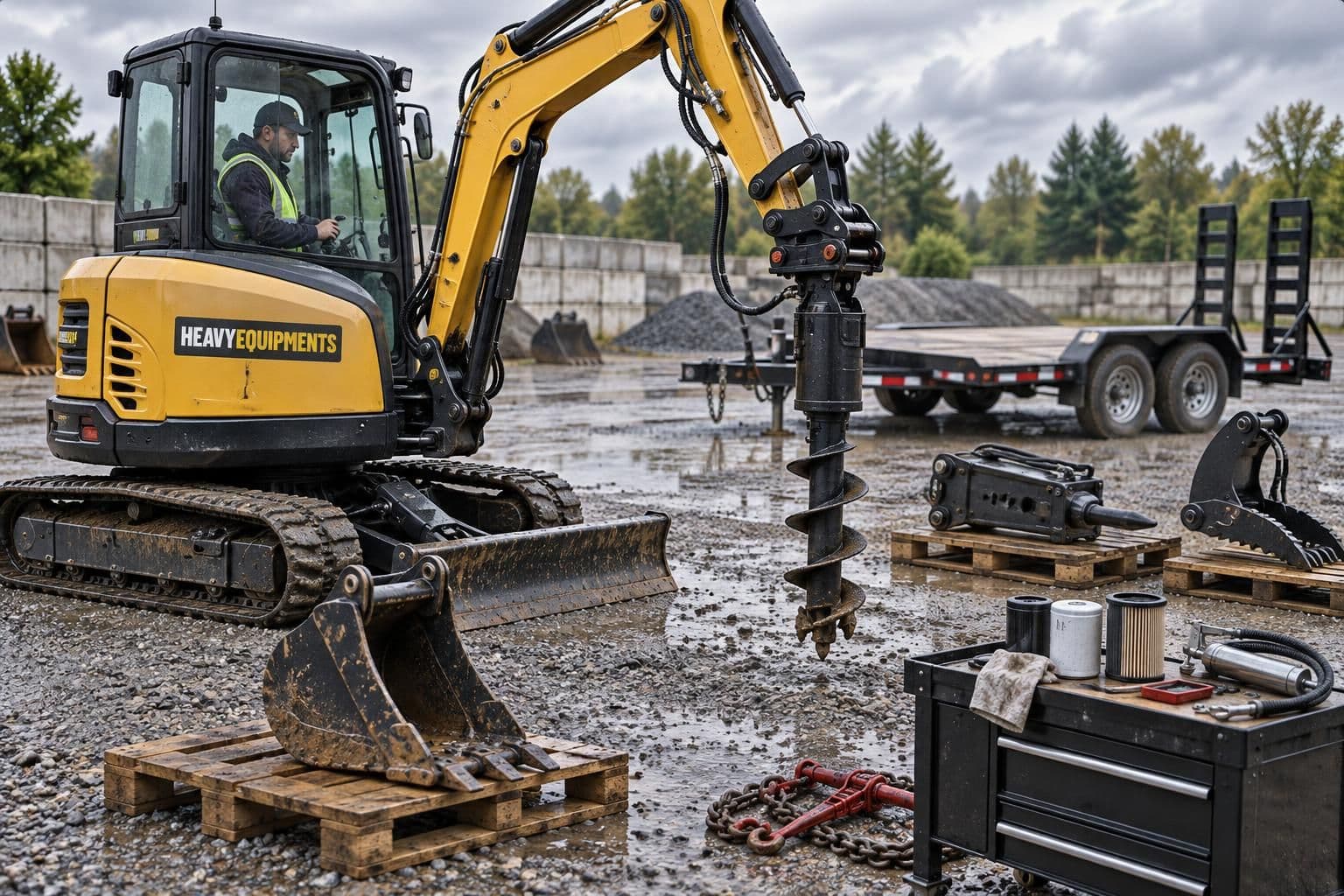
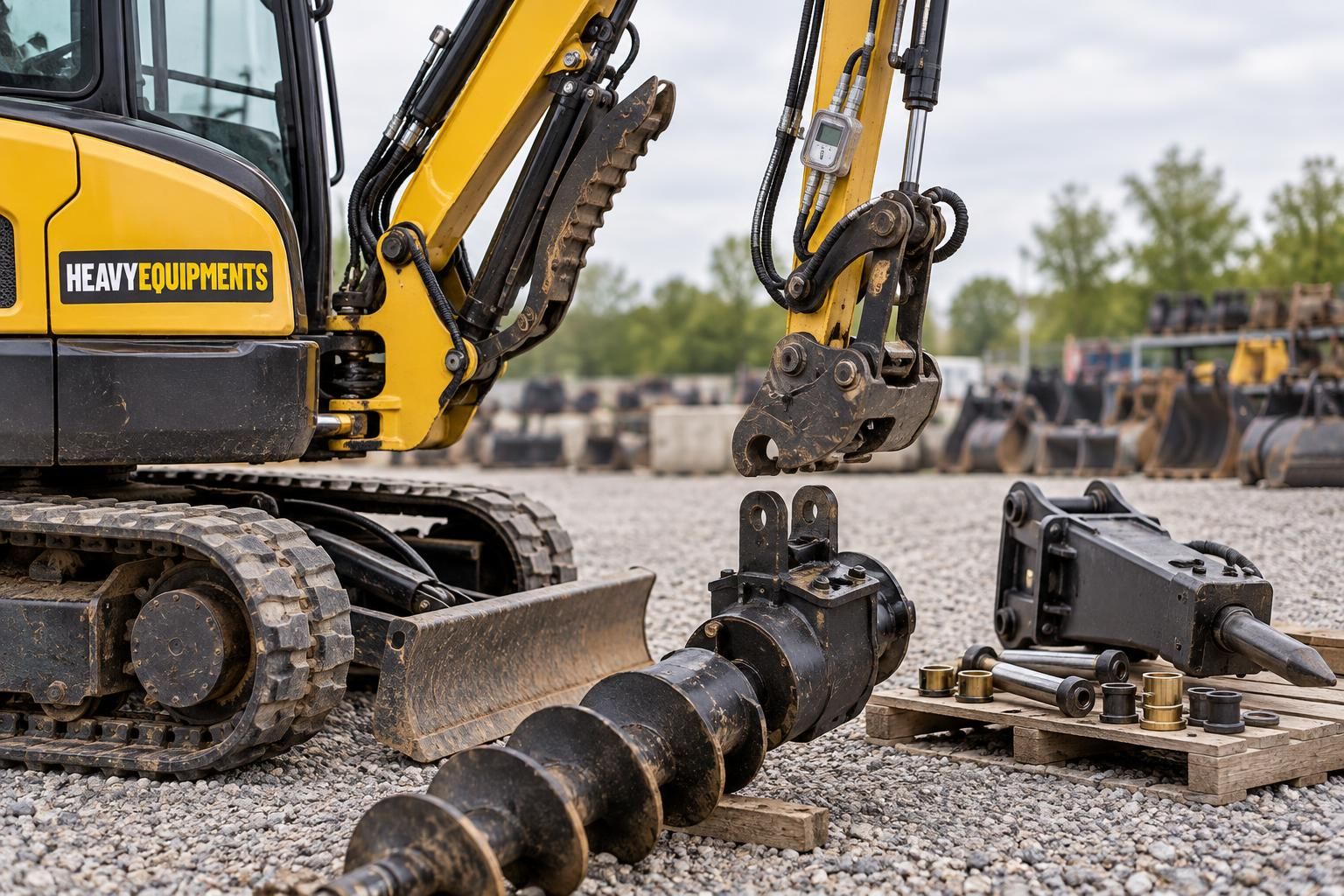
Mini excavator attachments can turn a small machine into the most productive tool on your site, but only if the mounting and hydraulics match. This guide explains how to size and spec thumbs, augers, and breakers for mini excavators, what “flow and pin sizes” really mean in practice, and how to use the spec snapshots below to choose attachments that suit your machine and work.
Start with fitment pins ears and couplers
Every attachment has to physically mount to your stick and linkage (or to your quick coupler). Before you think about hydraulic flow, confirm the pin group and coupler style you run today.
- For pin on mounting, measure the bucket pin diameter, the pin to pin center distance (stick to bucket), and the stick ear width (inside width between ears on the attachment). Measure what is on your machine now and match the attachment ear group to it.
- If you are running a pin grabber or wedge style coupler, buy attachments built for that coupler geometry. The right pin size in the ears is still required, and coupler compatible ears prevent tip radius or crowd angle issues.
- If an attachment ear group is close but not exact, bushings can adapt pin diameter within limits. When in doubt, spec ears or coupler lugs made for your exact machine.
- Verify that thumb tines will not foul the stick cylinder or bucket linkage through the whole curl range, especially on zero tail minis where packaging is tight.
Hydraulics 101 for thumbs augers and breakers
Three of the most popular mini excavator attachments each place different demands on your auxiliary hydraulics. Even without quoting numbers, you can match correctly by confirming the circuit type your machine provides and the circuit type the attachment needs.
Hydraulic thumbs
- A hydraulic thumb needs a dedicated auxiliary cylinder circuit on the boom or stick. A mechanical thumb uses linkage and manual positioning, no hydraulics required.
- Smooth modulation helps. Many minis use a pedal or a joystick button. Verify you have a controllable double acting circuit to open and close the thumb.
- Choose a thumb length and tine profile that matches your common bucket width and tooth spacing so the tips mesh properly across the curl arc.
Augers
- Auger drives need bidirectional flow for forward and reverse to clear holes. Make sure your auxiliary is two way and that your control layout supports reversing the flow.
- Some auger motors require a low pressure return through a case drain. Confirm whether your machine has a case drain port before choosing a drive that needs one.
- Check that the auger mount matches your coupler or pin group. Keep overall length reasonable for your machine’s stability and lift at full reach.
Breakers
- Most breakers use a single acting one way supply with a free return to tank. Confirm your auxiliary setup matches that requirement and that the return line is not restricted.
- Heavier minis tolerate larger breakers. For context, a micro like the Bobcat 316 weighs 760 kg (1676 lbs), while a larger mini like the Bobcat E63 is 6250 kg (13779 lbs). Size the breaker to your machine weight and structure.
- Clean oil, correct relief settings, and a proper nitrogen charge (breaker side) are essential for impact power and longevity.
Right size by machine class
Attachment expectations should scale with your machine. Consider a few examples using verified specs below.
- Micro and compact minis around 1 to 2 t. Models like the Yanmar SV08-1 at 1065 kg (2348 lbs) or the Yanmar VIO17 at 1740 kg (3836 lbs) excel with smaller, lighter thumbs, compact auger drives, and breakers sized conservatively to protect the front linkage.
- Core 2 to 4 t class. Machines such as the Takeuchi TB228 at 2810 kg (6195 lbs) and Kubota U35 at 3735 kg (8234 lbs) are common carriers for hydraulic thumbs, fence or post augers, and light to medium duty breakers.
- Heavier minis 5 to 6 t. Units like the Bobcat E55 at 5536 kg (12204 lbs) and Bobcat E63 at 6250 kg (13779 lbs) provide the mass and power headroom for larger thumbs, more aggressive auger drives, and heavier breakers.
Do not compare a mini’s attachment needs to a standard excavator such as the Caterpillar 320D2 at 21,900 kg and 108 kW. Pin groups and hydraulic circuits differ substantially.
Mini excavator spec snapshot to guide attachment matching
Use this table to gauge relative carrier size when shortlisting attachments. Larger operating weight and horsepower generally support heavier thumbs, larger auger drives, and bigger breakers. Max digging depth is shown for context on machine size and geometry.
| Model | Type | Weight (kg) | Weight (lbs) | Horsepower (kW) | Horsepower (HP) | Max Digging Depth (cm) | Max Digging Depth (in) |
|---|---|---|---|---|---|---|---|
| Kubota U35 | Mini Excavator | 3735 | 8234 | 21 | 28 | 317 | 125 |
| Kubota U35-4HGA | Mini Excavator | 3581 | 7895 | 17 | 23 | 299 | 118 |
| Kubota U35-4HG | Mini Excavator | 3715 | 8190 | 17 | 23 | 299 | 118 |
| Kubota U35-4GA | Mini Excavator | 3838 | 8461 | 17 | 23 | 299 | 118 |
| Takeuchi TB28FR | Mini Excavator | 3095 | 6823 | 16 | 22 | 259 | 102 |
| Takeuchi TB228 | Mini Excavator | 2810 | 6195 | 17 | 23 | 259 | 102 |
| Takeuchi TB23R | Mini Excavator | 2600 | 5732 | 13 | 18 | 256 | 101 |
| Takeuchi TB016 | Mini Excavator | 1598 | 3524 | 10 | 13 | 241 | 95 |
| Bobcat 316 | Mini Excavator | 760 | 1676 | 7 | 10 | 155 | 61 |
| Bobcat 331E | Mini Excavator | 3519 | 7758 | 30 | 40 | 393 | 155 |
| Bobcat E55 | Mini Excavator | 5536 | 12204 | 37 | 49 | 393 | 155 |
| Bobcat E63 | Mini Excavator | 6250 | 13779 | 44 | 59 | 411 | 162 |
| Yanmar VIO17-A | Mini Excavator | 1740 | 3836 | 10 | 14 | 235 | 92 |
| Yanmar VIO17 | Mini Excavator | 1740 | 3836 | 10 | 13 | 223 | 88 |
| Yanmar SV08-1 | Mini Excavator | 1065 | 2348 | 7 | 10 | 152 | 60 |
| Yanmar SV08-1B | Mini Excavator | 1065 | 2348 | 7 | 10 | 162 | 64 |
Simple checklist for any attachment order
- Machine make and model, for example a Kubota mini excavator like the U35 series, or a Bobcat E series mini.
- Mounting details, pin on or your coupler brand and model. Include measured pin diameter, pin centers, and stick ear width from your current bucket.
- Hydraulic circuit type available, two way (for augers), one way with return (for breakers), or a cylinder circuit (for hydraulic thumbs). Note pedal versus joystick control.
- Any special ports, for example case drain availability if the attachment needs it.
- Typical task, such as material handling and sorting (thumb), fencing or landscaping (auger), or demo and rock work (breaker). This helps right size the drive or hammer.
Practical tips that prevent fit up headaches
- Set thumbs first, buckets second. If you are adding a hydraulic thumb, match bucket width and tooth spacing to the thumb you choose. It is easier to set bucket inventory to a thumb than the other way around.
- Mind the hose routing. Augers and breakers move through large arcs. Add hose guards and keep slack managed to avoid pinch points at full curl and stick in.
- Use the heaviest pin group you can within spec. Tighter pins and correctly sized bushings improve control feel with a hydraulic thumb and reduce wear under breaker vibration.
- Warm up the oil. Breakers perform best with warm hydraulic oil and correct relief settings. A brief cycle before hammering protects both tool and carrier.
- Compare carriers before you buy. If you are choosing between models such as the Bobcat E55 and Bobcat E63, use our table and the spec compare tool to align attachment plans with carrier size.
- Cat or Kubota, the rules do not change. Whether you run a Cat mini excavator or a Kubota mini excavator, the same pin and coupler checks and hydraulic circuit matching apply.
Next steps for your setup
- Browse more carrier specs for minis in our equipment specs and line up your short list.
- Use Compare Specs to cross check operating weight, horsepower, and digging depth before you size attachments.
- Shop attachments ready for mini excavators, including thumbs, augers, and breakers, and verify coupler compatibility.
- For replacement bushings, couplers, or hoses, check parts and keep your pin group tight.
- To add another carrier or swap machines, see machines for sale or find a short term solution in rentals.