Essential Tractor Implements and Power Basics for Acreage Owners
A practical checklist of 12 essential tractor implements for acreage owners, plus what to check for PTO power, tractor weight, lift capacity and hydraulics with a spec table to help you size attachments safely.
Size tractor implements to your machine
The right tractor implements turn seat time into real productivity. The wrong match can stall your tractor or strain components. Before you buy, confirm four basics on your tractor (compact or utility alike):
- Match implement ratings to your tractor’s available PTO horsepower. Manufacturers publish this, don’t guess.
- Heavier tractors hold traction and handle ground engaging tools more safely. Ballast as needed.
- Confirm your 3 point hitch can lift and carry the implement’s full operating weight.
- Some implements such as a post driver, log splitter or loader need hydraulic flow. Compare your tractor’s pump output to the implement’s spec.
To make this concrete, see the spec table below for representative compact and utility models through high-horsepower machines. For example, the Massey Ferguson 1225 is a light compact with 18.1 kW (24.3 HP), 550.0 kg (1212.5 lbs) lift capacity and 9.8 LPM (2.6 GPM) pump flow, ideal for small, lighter-duty implements. Step up to utility tractors like the Kubota MX5800 at 42.9 kW (57.5 HP) with a 1300.0 kg (2866.0 lbs) lift, or the New Holland T4.75 at 55.2 kW (74.1 HP) and 2190.0 kg (4828.1 lbs) lift when you need heavier, wider implements. Hydraulic demand also jumps on some tools; note the T4.75’s 47.3 LPM (12.5 GPM) versus the 1225’s 9.8 LPM (2.6 GPM).
12 tractor implements every acreage needs
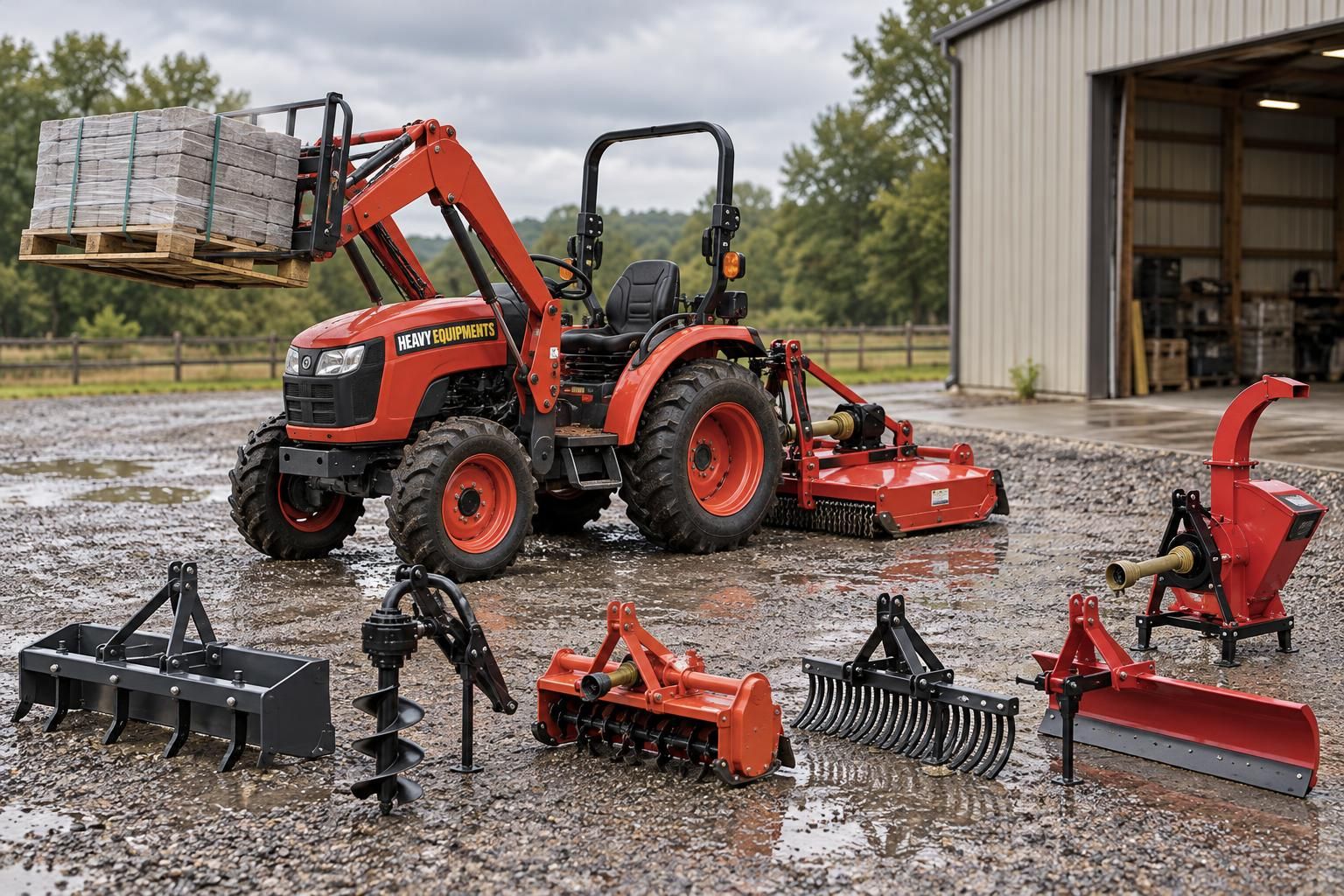
1) Rotary cutter (brush hog)
For knocking down pasture grass, saplings and field edges. Sizing is all about PTO power and tractor weight: you need enough power to keep blades spinning in heavy material, and enough mass for stability on uneven ground. Start with your PTO rating and keep the cutter’s width and duty class within what your tractor can safely handle.
2) Finish mower
Gives lawn-quality cuts on yards, lanes and building sites. These generally need less torque than brush cutters but still depend on steady PTO speed. Weight matters on slopes, ballast or wheel spacers may improve stability on compact tractors.
3) Box blade
A go-to for driveway maintenance, pad building and light earthmoving. Traction and tractor weight are key. Heavier tractors pull scarifiers more effectively. Check 3-point lift capacity so you can carry the box full of material without lifting strain.
4) Rear blade
Great for grading, windrowing and snow. Wider blades put more side load on the tractor, especially when angled. Ensure your tractor’s base weight and rear lift are up to the tool and that your tires are appropriately ballasted.
5) Landscape rake
Useful for debris cleanup, seedbed prep and light gravel work. It’s relatively light, but still confirm hitch capacity and consider your tractor’s width to avoid raking outside the tire tracks with a small compact.
6) Rotary tiller
For gardens and food plots. Tilling takes steady PTO power and low-speed control. Hydrostatic or shuttle transmissions help. Compact tractors can run narrower tillers; utility tractors can spin wider units in heavier soils, check the table below to choose a comparable tractor class.
7) Disc harrow
Levels and incorporates residue faster than a tiller on larger plots. It’s a ground-engaging implement that rewards tractor mass. If you’re on a light compact, take smaller passes and avoid deep cuts; utility tractors with higher weight and lift handle larger, heavier gangs.
8) Post hole digger (PTO auger)
Fence projects go faster with a PTO-driven auger. Confirm PTO compatibility and note that rocky soils may demand more tractor power. A stable, well-ballasted tractor keeps the auger straight, and your hydraulics should hold the implement steady during extraction.
9) Broadcast spreader
For seed, fertilizer and ice melt. These are light but put weight on the hitch when filled. Check 3-point lift capacity and transport carefully on slopes or with a full hopper.
10) Sprayer (3 point or trailer)
Pasture and orchard work often needs spraying. Confirm whether the sprayer uses the tractor’s hydraulics or a PTO pump and make sure your pump flow or PTO rating meets the sprayer’s spec. Liquid weight rises quickly, match tank size to your hitch capacity.
11) Pallet forks (3 point or loader)
Handy for moving pallets, logs and bulk bags. Here, lift capacity and front/rear ballast are the limiting factors. Compact tractors with modest lift ratings should keep loads close and low; utility tractors can safely handle heavier skids.
12) Snow blower (rear or front PTO)
For regions with real winter, a PTO snow blower clears lanes and yards fast. PTO power keeps the impeller from bogging in wet snow. Weight and tire setup matter for traction, especially on grades or when backing a rear mount unit.
What each tractor class can handle
Compact tractors are capable, but you’ll size implements conservatively. A Massey Ferguson 1225 with 18.1 kW (24.3 HP), about 680.0 kg (1499.1 lbs) base weight and 550.0 kg (1212.5 lbs) lift is well-suited to lighter cutters, narrow tillers, a small box blade and utility spreaders. Step up to a Massey Ferguson 1240 at 22.4 kW (30.1 HP) with 1300.0 kg (2866.0 lbs) lift and more hydraulic flow for wider and heavier-duty work. Utility models like the Kubota MX4800, MX5200 and MX5800 each provide a 1300.0 kg (2866.0 lbs) rear lift, coupled with their higher horsepower and 36.0 LPM (9.5 GPM) pump outputs (varies by model), they’re comfortable with bigger rotary cutters, wider rear blades and heavier pallet loads.
When you regularly pull larger, ground-engaging tools, more base weight and lift help. A New Holland T4.75 at 55.2 kW (74.1 HP), roughly 2830.0 kg (6239.1 lbs) operating weight and 2190.0 kg (4828.1 lbs) lift is a strong match for wider blades, discs and sprayers. A John Deere 6300 at 55.9 kW (75.0 HP) with a 2220.0 kg (4894.3 lbs) lift gives similar capability with different transmission and chassis options.
Large-acreage and custom operators may use high-horsepower row-crop or 4WD tractors for heavy, wide implements. Examples include New Holland 8870 or 9282, the Massey Ferguson 8680, and even crawler units like the John Deere 9570RX. These machines bring very high weight, lift capacity and hydraulic flow, making short work of big cutters, tillage tools and large-capacity sprayers, well beyond most homestead needs but useful for comparisons in the table below.
Representative tractors and specs for sizing implements
Use this table to benchmark your tractor against comparable models when choosing tractor attachments. Focus on horsepower, base weight, 3-point lift and hydraulic flow, then confirm PTO and hitch category in the implement’s manual.
| Model | Type | Horsepower | Weight | Rear Lift Capacity | Hydraulic Pump Flow |
|---|---|---|---|---|---|
| Massey Ferguson 1225 | Compact Utility Tractor | 18.1 kW (24.3 HP) | 680.0 kg (1499.1 lbs) | 550.0 kg (1212.5 lbs) | 9.8 LPM (2.6 GPM) |
| Massey Ferguson 1240 | Compact Utility Tractor | 22.4 kW (30.1 HP) | 1200.0 kg (2645.5 lbs) | 1300.0 kg (2866.0 lbs) | 22.7 LPM (6.0 GPM) |
| Kubota MX4800 | Utility Tractor | 35.0 kW (46.9 HP) | 1692.0 kg (3730.2 lbs) | 1300.0 kg (2866.0 lbs) | 36.0 LPM (9.5 GPM) |
| Kubota MX5200 | Utility Tractor | 38.9 kW (52.2 HP) | 1694.0 kg (3734.6 lbs) | 1300.0 kg (2866.0 lbs) | 36.0 LPM (9.5 GPM) |
| Kubota MX5800 | Utility Tractor | 42.9 kW (57.5 HP) | 1694.0 kg (3734.6 lbs) | 1300.0 kg (2866.0 lbs) | 36.0 LPM (9.5 GPM) |
| New Holland T4.75 | Utility Tractor | 55.2 kW (74.1 HP) | 2830.0 kg (6239.1 lbs) | 2190.0 kg (4828.1 lbs) | 47.3 LPM (12.5 GPM) |
| John Deere 6300 | Utility Tractor | 55.9 kW (75.0 HP) | 3860.0 kg (8509.8 lbs) | 2220.0 kg (4894.3 lbs) | |
| John Deere 60 | Row-Crop Tractor | 34.3 kW (46.0 HP) | 2630.0 kg (5798.2 lbs) | 33.7 LPM (8.9 GPM) | |
| New Holland 8870 | Row-Crop Tractor | 156.7 kW (210.1 HP) | 8230.0 kg (18144.0 lbs) | 5670.0 kg (12500.2 lbs) | 90.8 LPM (24.0 GPM) |
| New Holland 9282 | Farm Tractor | 194.0 kW (260.1 HP) | 11250.0 kg (24802.0 lbs) | 5895.0 kg (12996.2 lbs) | 170.3 LPM (45.0 GPM) |
| John Deere 9570RX | Agricultural Crawler Tractor | 425.1 kW (570.1 HP) | 25175.0 kg (55501.3 lbs) | 9070.0 kg (19995.9 lbs) | 435.3 LPM (115.0 GPM) |
| Massey Ferguson 8680 | Row-Crop Tractor | 238.7 kW (320.1 HP) | 11000.0 kg (24250.8 lbs) | 5000.0 kg (11023.1 lbs) | 99.9 LPM (26.4 GPM) |
Quick sizing tips you can apply today
- Match implement width and duty rating to your tractor’s PTO power and base weight. If your tractor’s specs resemble the compacts in the table, choose lighter, narrower tools; if they resemble the utilities, you have more headroom.
- Use your 3-point lift rating as a hard limit. Filled spreaders, heavy box blades and large cutters can exceed hitch capacity quickly.
- Hydraulic implements need flow. Compare your pump output to the implement’s requirement and avoid dead-heading or overheating low-flow systems.
- Balance matters. Ballast front or rear as needed to keep steering and braking effective, particularly with heavy 3-point loads.
- When in doubt, demo or rent first to confirm fit and performance before you buy.
Next steps for your equipment plan
Outfit your acreage with the right tools. Browse our tractor attachments catalog, check detailed tractor specs, and line up models side by side with Specs Compare. If you’re still shopping for the right machine, see what’s available in your area under tractor for sale, or line up a trial weekend through rentals. For wear parts and maintenance items before the season, head to parts.