Compact Wheel Loaders for Snow and Pallet Work, Tips and Specs
Practical setup and operating tips to get the most from a compact wheel loader in snow and pallet handling, plus a side by side spec snapshot of popular models.
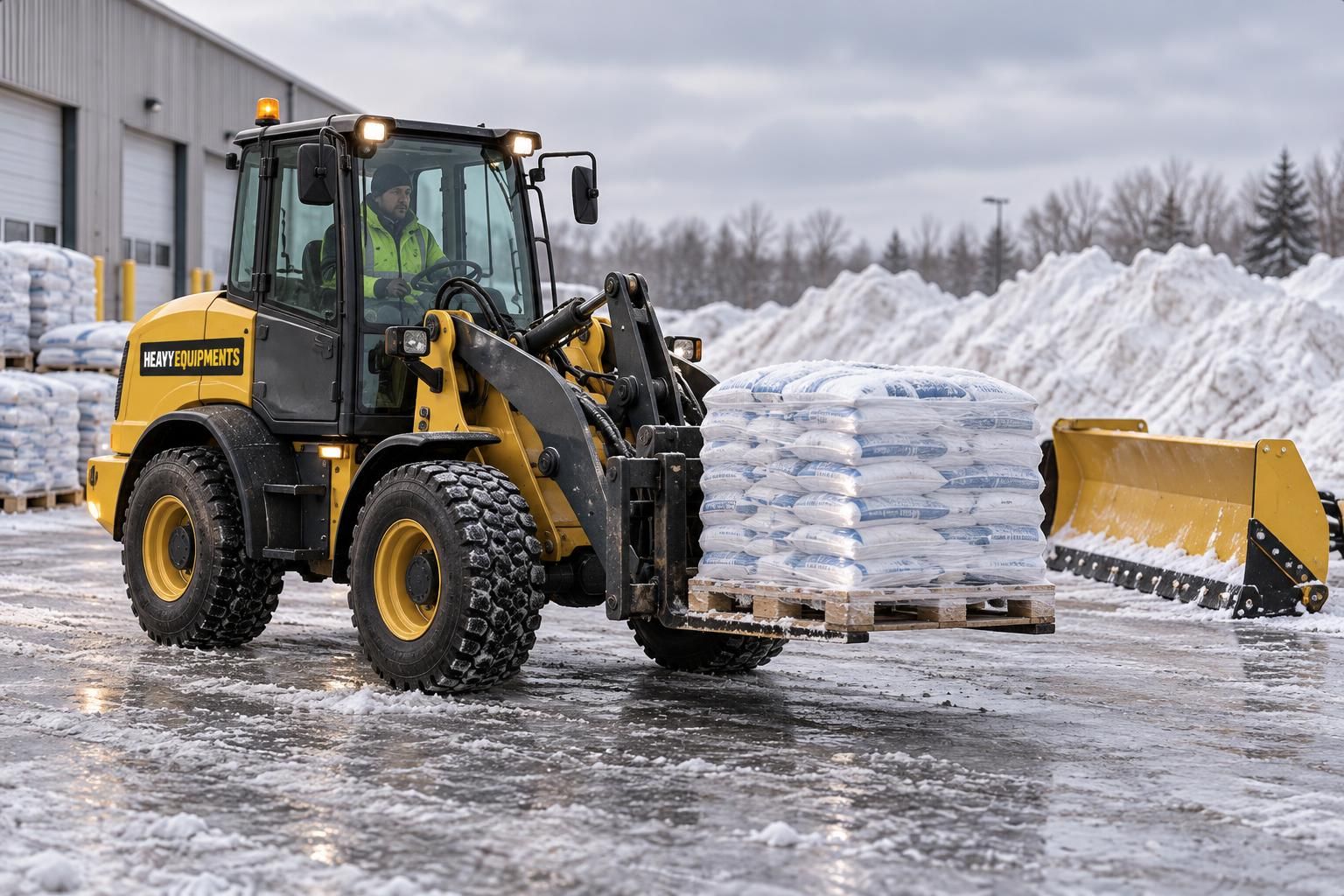
Compact wheel loaders have become go-to machines for snow removal and pallet handling in yards, terminals, and light industrial sites. They combine roadable travel speeds, cab visibility, and stout hydraulics with the ability to switch between a pusher, bucket, and forks in minutes. Below are practical setup pointers, operating techniques, and a spec snapshot of commonly used compact and small mid-sized loaders you’ll see on snow routes and in warehouse yards.
Why compact wheel loaders suit snow and pallets
Compared with a skid steer loader or compact track loader, a compact wheel loader typically offers:
- Higher travel speeds to shuttle between sites or sections of a property. For example, loaders like the Caterpillar IT28G list up to 60.7 km/h (37.7 mph), and models such as the John Deere 544D show 44.9 km/h (27.9 mph), which helps cover long runs and road crossings.
- Excellent visibility and stability for fork work and stacking.
- Articulated steering and a comfortable cab for long shifts in winter conditions.
That said, skid steers and compact track loaders still shine in tight, confined spaces or on delicate surfaces. If your work mixes long pushes, road travel, and frequent pallet moves, a compact wheel loader hits a strong productivity sweet spot.
Snow setup tires attachments and hydraulics
Tires and traction aids
- Select winter or all-season tread patterns that clear slush and maintain contact on ice. Chains can add bite for steep grades, but confirm clearance.
- Ballast and tire pressures should match your attachment and job profile; follow manufacturer guidance for your model.
Pushers buckets and plows
- Snow pushers are efficient for lots and terminals, minimizing windrows and protecting surfaces.
- High-capacity buckets help with backdragging docks and tight corners.
- Angle plows are useful for long, narrow runs and windrowing. If you run hydraulic functions (angle, wings), verify available hydraulic flow on your machine. For example, the John Deere 324J lists pump flow of 95.0 LPM (25.1 GPM), an indicator of the kind of flow many compact loaders provide for hydraulic attachments.
Roading between sites
- Take advantage of higher travel speeds when safe and permitted. Loaders such as the Caterpillar 928F list 39.4 km/h (24.5 mph) and the Caterpillar 938F 38.0 km/h (23.6 mph), which can shorten cycle times across large properties.
- For longer runs, consider a mid-sized unit like the Caterpillar 950 GC for heavier push and carry. It’s a different size class, but it illustrates how stepping up in weight and engine power can help in deep or wet snow.
Forks and pallet handling best practices
- Know your machine’s tipping capacity and follow the manufacturer’s load charts. Tipping capacity varies widely by model; see the table below for examples on compact and small mid-sized loaders.
- Attachment weight matters. A fork carriage and long forks shift the load center forward, reducing usable capacity versus a bucket.
- Keep forks low during travel for stability, tilt back to stabilize the pallet, and avoid abrupt steering inputs at speed, especially on snow or ice.
- Use a load backrest when stacking pallets to keep loads from shifting rearward.
- On uneven yards, approach with the mast/forks level, lift only as high as needed, and square the pallet before placing.
Where stacking is routine, choose a loader with adequate baseline stability. Models with published tipping capacities, like the Liebherr L524 at 7502.4 kg (16540 lbs) or the John Deere 544D at 7352.7 kg (16210 lbs), provide a useful reference point when selecting fork and pallet sizes, always within OEM limits.
Operating techniques for winter productivity
- Plan push patterns that minimize backtracking. Windrow to the perimeter first, then clean up with the pusher or bucket.
- Stack with care: build ramps gradually and avoid overhanging piles that can slump. Keep people and vehicles clear of piles.
- Manage traction: start smoothly, avoid spinning tires, and modulate travel speed to conditions. Even compact loaders with modest horsepower can be very productive when kept in steady, controlled pushes.
- Pre-stage pallets to reduce travel distance and turns. On mixed snow/warehouse duties, group fork work into blocks between plow passes to limit attachment swaps.
Specs snapshot compact loaders used for snow and forks
The table below compiles key specs from a range of compact and small mid-sized wheel loaders often seen in snow and pallet-handling work. Use it to shortlist machines by weight, power, speed, and (where available) tipping capacity. For deeper research, browse our spec database and use Spec Compare.
| Model | Operating weight | Power | Max speed | Tipping capacity |
|---|---|---|---|---|
| Caterpillar 928F | 11172.0 kg (24630 lbs) | 89.5 kW (120 hp) | 39.4 km/h (24.5 mph) | N/A |
| Caterpillar 938F | 13031.7 kg (28730 lbs) | 104.4 kW (140 hp) | 38.0 km/h (23.6 mph) | N/A |
| Caterpillar IT28G | 12133.6 kg (26750 lbs) | N/A | 60.7 km/h (37.7 mph) | N/A |
| Volvo LM840 | 9570.8 kg (21100 lbs) | 82.0 kW (110 hp) | 26.6 km/h (16.5 mph) | 4218.4 kg (9300 lbs) |
| Volvo LM841 | 9870.2 kg (21760 lbs) | 83.5 kW (112 hp) | 26.6 km/h (16.5 mph) | 4300.1 kg (9480 lbs) |
| Volvo LM845 | 9548.1 kg (21050 lbs) | 83.5 kW (112 hp) | 29.9 km/h (18.6 mph) | 5901.2 kg (13010 lbs) |
| Volvo LM846 | 10201.3 kg (22490 lbs) | 89.5 kW (120 hp) | 30.1 km/h (18.7 mph) | 6799.3 kg (14990 lbs) |
| Komatsu WA200-5 | 9471.0 kg (20880 lbs) | 91.7 kW (123 hp) | 34.6 km/h (21.5 mph) | N/A |
| Komatsu WA270-7 | N/A | 111.0 kW (148.9 hp) | 38.0 km/h (23.6 mph) | N/A |
| Liebherr L514 | 7720.1 kg (17020 lbs) | 73.1 kW (98 hp) | 30.1 km/h (18.7 mph) | 5674.4 kg (12510 lbs) |
| Liebherr L524 | 10400.9 kg (22930 lbs) | 90.2 kW (121 hp) | 40.1 km/h (24.9 mph) | 7502.4 kg (16540 lbs) |
| John Deere 344K | 8509.4 kg (18760 lbs) | 72.3 kW (97 hp) | N/A | N/A |
| John Deere 544D | 10278.4 kg (22660 lbs) | 85.8 kW (115 hp) | 44.9 km/h (27.9 mph) | 7352.7 kg (16210 lbs) |
| John Deere 544GTC | 11167.4 kg (24620 lbs) | 89.5 kW (120 hp) | 38.3 km/h (23.8 mph) | N/A |
Choosing size and machine type
- Lots and terminals: Favor units with higher travel speed and enough weight to push wet snow. Compact loaders in the 7 to 13 metric ton range (see weights in the table) are common for this role.
- Mixed snow and pallet work: Balance speed with tipping capacity and visibility. Models like the Liebherr L524, John Deere 544D, or Volvo LM846 (see capacities above) offer a stability baseline for regular fork work.
- Primarily indoor/yard pallets: You may still prefer a skid steer loader for very tight aisles. Where outdoor travel and snow are in the mix, a compact wheel loader’s speed and ground clearance are advantages.
Next steps and resources
Use our Spec Compare tool to line up two or more models from the table. Browse full details in Specs, and find the right implements in Attachments. When you’re ready to add to the fleet, check current For Sale listings, short-term Rentals, and keep uptime strong with Parts.