Compact Track Loader Undercarriage Tension, Wear and Service
Practical guidance to extend compact track loader undercarriage life. Set track tension, inspect wear, and use simple service rhythms with a spec snapshot.
The undercarriage on a compact track loader does the hard, dirty work, it carries the whole machine, transmits torque, and absorbs constant turning. Keep it tight and clean, and inspect it often to avoid costly downtime. This guide covers track tension basics, high wear parts to watch, and service rhythms that work in real fleets. We have also included a quick spec snapshot so you can relate undercarriage stress to machine size and rated capacity. If you are looking up Cat 259D specs or any other CTL to set expectations, use the table below as a starting point.
Undercarriage stress and CTL spec snapshot
Undercarriage life is tied to the loads you put through it: operating weight, rated operating capacity (ROC), and how you turn and travel, plus how you carry. Heavier machines with higher ROC move more material, but also put more force through sprockets, idlers, rollers, and track carcasses. Use the table to compare operating weight and load ratings across common compact track loaders and plan your maintenance cadence accordingly.
| Model | Operating Weight | ROC (50% Tipping) | Tipping Load |
|---|---|---|---|
| Caterpillar 259D3 | 4077.8 kg (8990 lbs) | 1301.8 kg (2870 lbs) | 2608.2 kg (5750 lbs) |
| Caterpillar 259d | 4012.5 kg (8846 lbs) | 1315.4 kg (2900 lbs) | 2630.8 kg (5800 lbs) |
| Caterpillar 289D3 | 4848 kg (10688 lbs) | 1880 kg (4130 lbs) | 3750 kg (8255 lbs) |
| Caterpillar 297c | 4640 kg (10229 lbs) | 1920 kg (4239 lbs) | 3841 kg (8468 lbs) |
| Caterpillar 299c | 4867.0 kg (10730 lbs) | 1882.4 kg (4150 lbs) | 3782.1 kg (8338 lbs) |
| Caterpillar 299d3 | 5200.0 kg (11464 lbs) | 2254.4 kg (4970 lbs) | 4511.1 kg (9945 lbs) |
| Caterpillar 299D3 XE | 5379.7 kg (11750 lbs) | 2313.3 kg (5100 lbs) | 4626.6 kg (10200 lbs) |
| Bobcat T590 (solid-mounted) | 3512.6 kg (7744 lbs) | 1360.8 kg (3000 lbs) | 2721.6 kg (6000 lbs) |
| Bobcat T595 | 3653.7 kg (8055 lbs) | 1425.2 kg (3142 lbs) | 2850.8 kg (6285 lbs) |
| Bobcat T595 T4 V2 | 3638.7 kg (8022 lbs) | 1425.2 kg (3142 lbs) | 2956.1 kg (6517 lbs) |
| Bobcat T650 | 4281.9 kg (9440 lbs) | 1664.7 kg (3670 lbs) | 3330.7 kg (7343 lbs) |
| Bobcat T740 | 4655.2 kg (10263 lbs) | 2063.8 kg (4550 lbs) | 4147.2 kg (9143 lbs) |
| John Deere 325g | 4309.1 kg (9500 lbs) | 1678.3 kg (3700 lbs) | 3356.6 kg (7400 lbs) |
| John Deere 331g | 5397.7 kg (11900 lbs) | 2009.4 kg (4430 lbs) | 1524.1 kg (3360 lbs) |
| John Deere 333g | 6350.3 kg (14000 lbs) | 2630.8 kg (5800 lbs) | 5275.3 kg (11630 lbs) |
| John Deere 333d | 5034.9 kg (11100 lbs) | 2143.2 kg (4725 lbs) | 4275.1 kg (9425 lbs) |
| John Deere CT332 | 4915 kg (10825 lbs) | 2088 kg (4600 lbs) | 4177 kg (9200 lbs) |
| Case TV370 | 4370 kg (9630 lbs) | 1682 kg (3700 lbs) | 3356 kg (7400 lbs) |
| Case Tv380 | 4785.4 kg (10550 lbs) | 1723.7 kg (3800 lbs) | 3447.3 kg (7600 lbs) |
| Case TV450 | 4808.1 kg (10600 lbs) | 2041.2 kg (4500 lbs) | 4082.3 kg (9000 lbs) |
| Case Tr340 | 4535.9 kg (10000 lbs) | 1406.1 kg (3400 lbs) | 3084.4 kg (6800 lbs) |
| Case Tv620b | 7302.8 kg (16100 lbs) | 2812.3 kg (6200 lbs) | 5624.5 kg (12400 lbs) |
| Kubota SVL65-2 | 4218.4 kg (9300 lbs) | 1270.0 kg (2800 lbs) | 2722.0 kg (6000 lbs) |
Track tension basics and correct setup
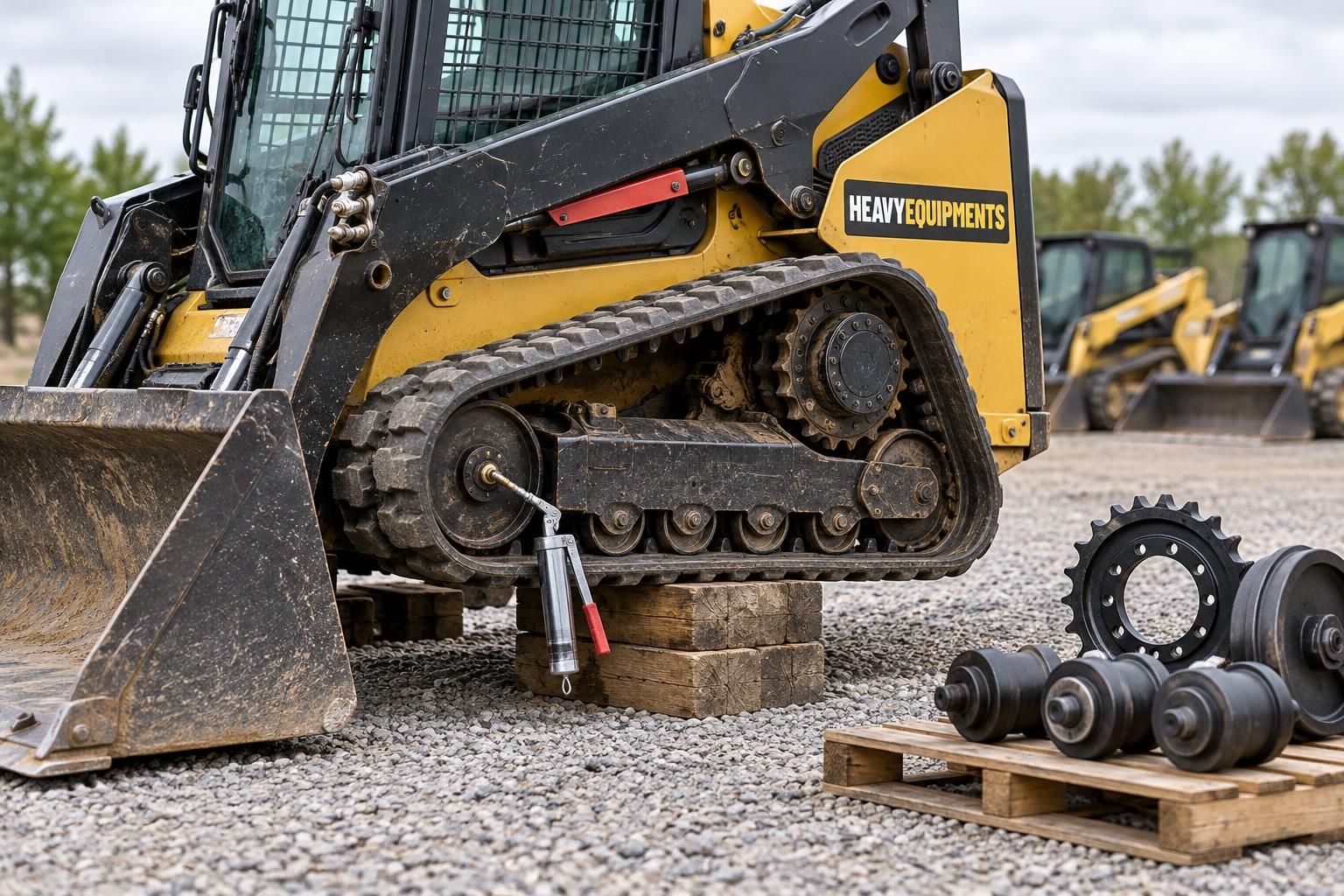
Compact track loader tension is typically controlled by a grease filled adjuster behind the front idler. Too loose and you will see de-tracking and ratcheting on the sprocket, with accelerated lug wear. Too tight and you will cook bearings, stretch tracks, and lose efficiency.
How to check and adjust (follow your model’s manual for exact method):
- Clean the undercarriage first so packed mud does not give you a false read.
- Park on level ground with the bucket empty and boom lowered. If the OEM method calls for it, safely raise and rotate the track to inspect the full circumference.
- Measure track sag where your manual specifies (commonly at the mid-span between the front idler and the sprocket). Compare to spec.
- To tighten, add grease to the adjuster until sag meets spec. To loosen, carefully open the bleed fitting to release grease. Make small changes, then move the machine forward and back to settle the track and recheck.
- Recheck after working in mud, snow, or fine sand. Conditions change tension quickly.
High wear parts and what to watch
Whether you run a smaller loader or a high capacity track loader, the wear patterns are similar. Build a habit of finding these early:
- Rubber tracks, look for torn or chunked tread, sidewall cuts, exposed cords, and cracked or sheared guide lugs. Consistent de-tracking suggests alignment issues or tension that is out of spec.
- Drive sprockets, hooked or sharp teeth point to worn tracks or mis-tension. Side wear on tooth flanges can indicate alignment problems or frequent hard turns.
- Front idlers and bottom rollers, check for oil leaks or wobble, and watch for flat spots. Seized or low lube rollers amplify heat and wear the track carcass.
- Carrier or top rollers, listen for rumble and check for binding. A frozen carrier roller can chew the inner surface of a track quickly.
- Final drives and motors, inspect for leaks at motor seals and lines. Contamination or low oil will take out gears and bearings fast.
- Frame and guards, bent or missing rock guards let debris ride the track in. Damaged guide lugs often follow.
Service intervals you can stick to
You do not need a stopwatch, just a consistent rhythm. Use this as a practical maintenance cadence alongside your OEM manual:
- Daily, walk the machine. Knock out packed material from sprockets, idlers, and around the adjuster. Visually check track tension and alignment. Look for leaks at rollers, idlers, and final drives.
- Weekly or after harsh conditions, give each side a full rotation and inspect track carcass, guide lugs, and sprocket teeth. Check roller and idler condition and hardware tightness. Wash the undercarriage and let it dry to prevent corrosion.
- After mud, snow, or sand, clean and recheck tension. Wet, fine material can hide inside guards and alter sag.
- Seasonal or off season, inspect all rollers and idlers for free movement and leaks, evaluate track life remaining, and plan replacements in pairs (tracks with sprockets) to protect new parts.
- After any de-track, inspect guide lugs, hoses, guards, and drive lines before returning to work. Reset tension per spec.
Operating habits that extend undercarriage life
- Turn smart. Avoid frequent counter rotation. Use 3 point turns and keep turns wider when possible, especially on abrasive surfaces.
- Match speed to ground. High speed travel on rock or asphalt builds heat and scuffs tread. Slow down over curbs, ruts, and transitions.
- Mind side loads. Keep loads low and minimize side hilling with a heavy bucket. Side loading drives wear into rollers, idlers, and track sidewalls.
- Clean often. Packed material forms hard “rollers” that derail tracks and starve components of cooling air.
- Load and transport straight. Drive straight up ramps and center the machine to avoid prying loads into one side of the undercarriage.
Replacement strategy what to pair and when
When rubber tracks are at the end, plan on new sprockets as well. Worn teeth will quickly damage a fresh track, and new teeth will accelerate wear on an old carcass. Replace leaking or rough rollers and idlers before they seize and cut into the track. If your loader uses a solid mounted undercarriage like the Bobcat T590, expect more shock transfer on hard ground. Soften your turns and reduce travel speed on rough surfaces. On torsion suspended systems, keep an eye on bogie movement and bushings, excess play shows up as cupped tread wear and vibration.
When you spec replacement tracks, match the pattern and width to your soil and work type. Wider is not always better. Choose for traction and cleanout in your most common conditions, and follow the manufacturer’s tension spec after installation.
Next steps for parts and specs
- Compare compact track loader specs across brands and sizes: Specs catalog and side-by-side Compare.
- Shopping or staging work? Browse For Sale and Rentals.
- Need tracks, rollers, or sprockets? Check Parts and related Attachments.
Whether you run a smaller compact track loader or a high ROC machine, the same habits apply. Keep tension set correctly and the iron clean, and keep inspections steady so the undercarriage keeps earning instead of burning your maintenance budget.