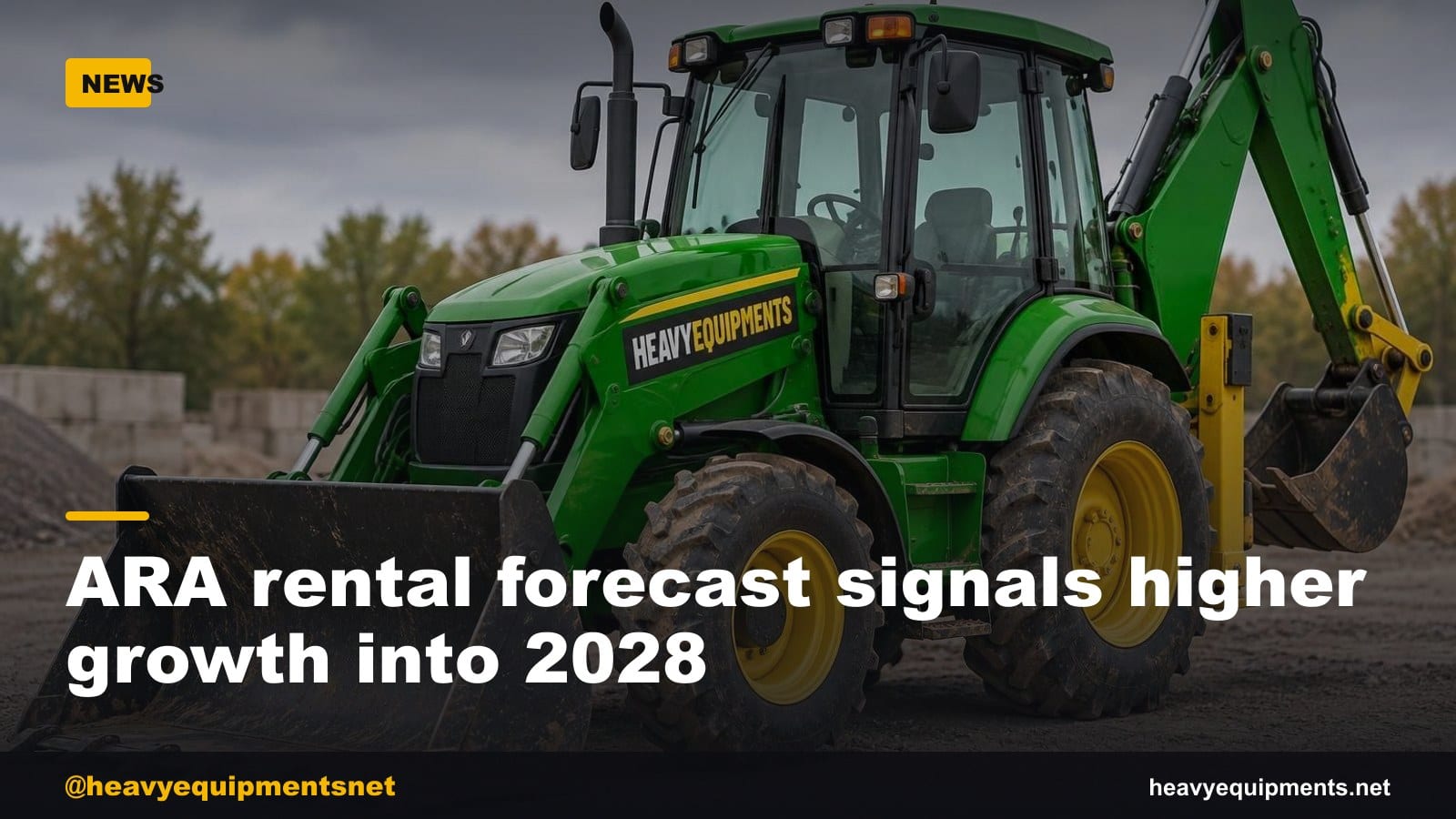
ARA rental forecast signals higher growth into 2028
ARA lifts its outlook for U.S. equipment and tool rental. Contractors near large projects should expect stronger demand and plan fleet moves now.
ARA rental forecast points to a stronger 2026 finish and faster rental growth after that. The American Rental Association projects the combined U.S. construction and industrial equipment and general tool rental market to rise 4.9 percent in 2026 to 84.6 billion, up from the prior projection of a 3.4 percent increase to 83.5 billion.
Beyond 2026, the outlook shows combined U.S. rental revenue growth of 5.3 percent in 2027 and 6.1 percent in 2028. The association says customers continue to rely on rental, with the biggest gains tied to states hosting large projects and infrastructure work. Residential needs to improve to broaden the footprint. This update comes via compactequip.com.
Updated growth path
The revised forecast marks a firmer turn upward for rental. The industry closing 2026 at 84.6 billion would top the previous-quarter view by 1.1 billion. On the trajectory provided, 2027 and 2028 accelerate from 2026, with 5.3 percent and 6.1 percent growth respectively. The forecasting partner cited resiliency across construction as uncertainty eases.
Large scale projects are the swing factor. Where there are data centers, infrastructure jobs, and similar activity, equipment demand is described as excellent. Elsewhere, construction and manufacturing remain relatively flat, which keeps rental revenue growth dependent on deeper adoption.
Where demand is strongest
States with bigger projects are driving the gains, according to the association. That lines up with what many fleets see on the ground, from heavy civil and utility work to site development around high power users. If you operate near a data center build or a public works corridor, expect tighter availability and higher utilization on earthmoving, material handling, and aerials. The association also notes that residential is lagging, which can cap rental momentum in housing heavy regions until that segment picks up.
For much of the country without a marquee project, growth requires more contractors shifting work toward rental. That can mean adding rental to cover peaks rather than stretching owned iron, or supplementing a core fleet with specialty tools to chase work that would otherwise be out of reach.
Rates, inflation and tariffs outlook
The forecasting firm behind the update expects uncertainty to fade in 2027. Inflation is projected to taper, which could allow interest rates to stabilize and possibly drop late in 2027. The analysis also points to potential easing of tariffs, especially between the U.S. and Mexico, as a reason for improved momentum.
What that means on the job, financing could get less restrictive as 2027 progresses, and cross border supply chains may move a bit freer if tariffs ease. That combination would support steadier availability of machines and parts, and it could make medium term rentals or fleet refresh plans easier to schedule.
Canada snapshot
Canada’s combined construction and industrial equipment and tool rental industry is expected to close 2026 at 6.2 billion, with 2027 growth of 4.8 percent. That is a slight softening from a 5.2 percent growth expectation and 6.3 billion total in the previous projection. The analysis ties slower overall economic growth to tariff impacts, while noting a shift toward infrastructure and affordable housing that supports rental utilization.
Canada’s most recent budget includes a Mega Project Deduction aimed at spurring large private investment. That mirrors the U.S. experience where big projects have underpinned rental strength, and it suggests Canadian rental could track closer to U.S. performance where those incentives translate into starts.
Event rental outlook
The event rental segment shows little change in direction, with the U.S. forecast expecting 10 percent growth to close 2026 at 6.2 billion. Beyond that, the forecast calls for 13.1 percent growth in 2027 and 7.9 percent in 2028. For contractors and farmers who also run seasonal event gear, that arc points to steady demand and busier calendars, with a sharper ramp in 2027 before easing a bit in 2028.
What to do now
The forecast comes from ARA’s Rentalytics program and analysis by S&P Global Market Intelligence, and the message is clear enough. Rental is holding up despite headwinds, and it improves as large projects pull more equipment to active sites. If you run a small fleet or depend on rental to bridge gaps, use the next few quarters to get in front of the curve.
- Pre book machines early if you operate near data centers, infrastructure corridors, or other mega projects
- Line up secondary suppliers for aerials, dirt, and tool categories to cover overlaps and outages
- Time big commitments so you can revisit terms as 2027 financing conditions stabilize
- Shift sales focus toward non residential and public work if housing in your area is slow
- If you work along the U.S. Mexico corridor, watch tariff headlines that could affect availability
How this affects own versus rent decisions
With utilization improving around large jobs, rental can help you take on additional scope without overextending capital. The 2027 and 2028 growth path also suggests more work will land in the pipeline, which argues for keeping rental accounts active and credit ready so you can scale quickly. In quieter regions, the note about flat construction and manufacturing means rental revenue only grows strongly with increased adoption, so be deliberate about where rental fills gaps, from specialty attachments to backup units during peak weeks.
This update, reported by compactequip.com, is not a signal to buy everything or sit on your hands. It is a green light to protect availability near big builds, keep options open on financing as 2027 approaches, and push into work types that are attracting the most investment. The takeaway, if you work where the cranes and trenchers already are, book earlier and expect tighter supply. If you do not, use rental to chase the projects showing life while you wait for housing to re engage.